Verified on 2026-11-07 against
strands-agents1.63.0, Python 3.11 and Bedrock inus-east-1. Every number below came out of a run, and the setup steps live inREADME.md. The model isamazon.nova-pro-v1:0on Amazon Bedrock.
An agent can remember your name across a restart and still lose it seven turns later in the same conversation. Those are two separate failures, and fixing one does nothing for the other.
Article 01 established that an agent’s state is one list of messages and that the conversation is the only channel into the model. Article 03 bounded a single call. This post follows that list through a restart, a window and a summary, and measures where each one fails.
It still knows you after a restart#
The simplest memory test runs as two separate OS processes.
from strands import Agent
from strands.models import BedrockModel
from strands.session import FileSessionManager

model = BedrockModel(model_id="amazon.nova-pro-v1:0", region_name="us-east-1")
session_manager = FileSessionManager(
    session_id="restart-demo", storage_dir="./sessions_tmp"
)
agent = Agent(model=model, session_manager=session_manager, callback_handler=None)
agent("My name is Pin and my favorite number is 42. Just acknowledge, one short sentence.")
The first process answers “Hello Pin, it’s great to know that 42 is your favorite number!” and
exits. Nothing stays in memory. The second process shares nothing with the first except that
directory, and it repeats the same imports and the same three setup statements with the same
session_id. The repository keeps both phases in one file and branches on sys.argv[1], which is
why the figure runs the script twice. If you copy the block above into a second file, keep all four
statements; the call alone raises NameError.
print(agent("What is my name and my favorite number?"))It answers “Your name is Pin and your favorite number is 42.” and then adds a caveat about not storing personal information. No variable carried the fact across the process boundary. A file did.
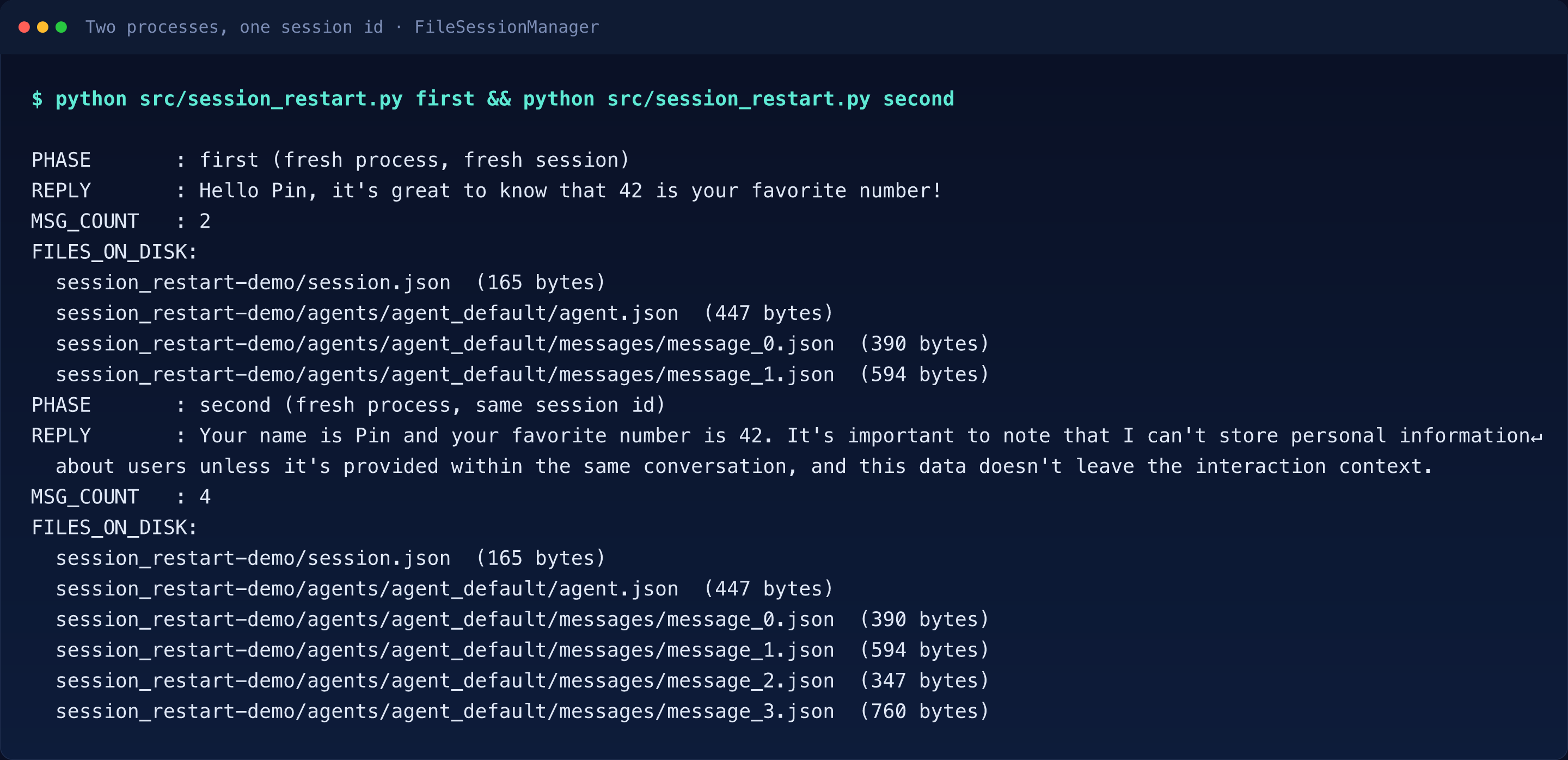
The cost is visible on disk. After the first run the storage directory holds four files: a
session.json of 165 bytes, an agent.json of 447 bytes, and one JSON file per message,
message_0.json at 390 bytes and message_1.json at 594 bytes. After the second run there are
six. The message count and the file count move together, one file per message, which is the layout
the class docstring draws at
file_session_manager.py:31.
That layout makes a session cheap to append to, and it makes the transcript readable without the
SDK. When an agent misbehaves at 3 a.m.,
cat agents/agent_default/messages/message_17.json answers more questions than a debugger. The
snippets in this post use ./sessions_tmp for readability; the scripts derive the directory from
their own location, so on disk it is src/sessions_tmp.
The three things living in agent.json#
The 447-byte file from the restart run holds an empty state, because that script never sets any. Open the file a state test writes instead, 528 bytes including two timestamps, and the word memory starts to come apart.
{
  "agent_id": "default",
  "state": {
    "visits": 1,
    "user": { "name": "Pin", "plan": "pro" }
  },
  "conversation_manager_state": {
    "__name__": "SlidingWindowConversationManager",
    "removed_message_count": 0,
    "model_call_count": 0
  },
  "_internal_state": {
    "interrupt_state": { "interrupts": {}, "context": {}, "activated": false },
    "model_state": {}
  }
}
That file arrived after two agent.state.set calls and one turn, and it holds three kinds of
memory side by side. The state block is your key-value store, written by application code. The
conversation_manager_state block is bookkeeping owned by the window manager, including a counter
of messages it has already removed. The _internal_state block belongs to pause and resume
handling; for a plain chat agent it stays empty, and it appears here only because it shares the
same restore path. All three travel together, because restoring the transcript without the window
counters would make the agent re-trim history it had already trimmed.
These three blocks are not the three lanes drawn later. The lanes are the whole session on disk,
the window in memory and the state store; inside agent.json, the state store is one block among
three.
From here on, state means the agent.state key-value store, not the message list. The SDK uses
the same word for both objects, and keeping them apart is half of this article.
set and get take a string key, and values must survive a round trip through JSON. The check
happens at write time, which turns a corrupt-file bug into a local error, and the message names
the permitted types:
ValueError: Value is not JSON serializable: object. Only JSON-compatible types (str, int, float, bool, list, dict, None) are allowed
The type behind the store is JSONSerializableDict, so an arbitrary Python object cannot enter it
in the first place. A set() call only mutates memory, though. State reaches disk when the session
manager flushes, which happens on the next agent invocation. A process that sets state and exits
before calling the model persists nothing.
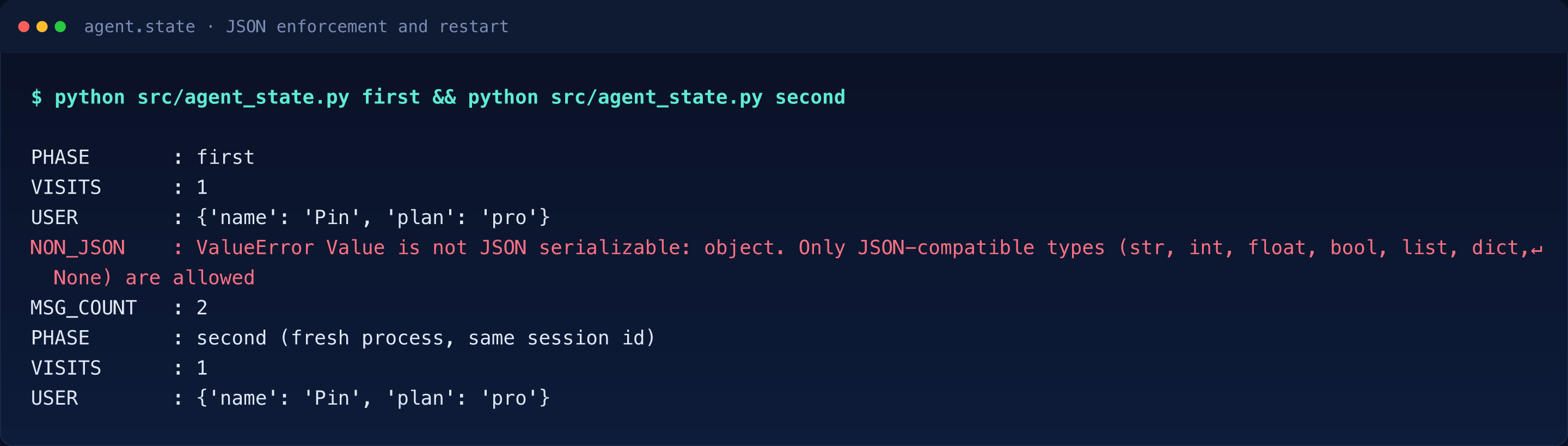
The distinction worth keeping is who reads which store. Messages are for the model. State is for your code. A plan id, a retry budget, the last tool result you care about, none of that needs to occupy the window, and none of it should be reconstructed by asking the model to remember.
One file instead of six#
The message log is one way to put a session on disk, and the SDK ships a second one that answers the same restart test differently.
from strands.session import SnapshotSessionManager
from strands.storage import LocalFileStorage

session_manager = SnapshotSessionManager(
    session_id="snapshot-demo",
    storage=LocalFileStorage(base_dir="./snapshots_tmp"),
    save_latest_on="message",
)
agent = Agent(model=model, session_manager=session_manager, callback_handler=None)
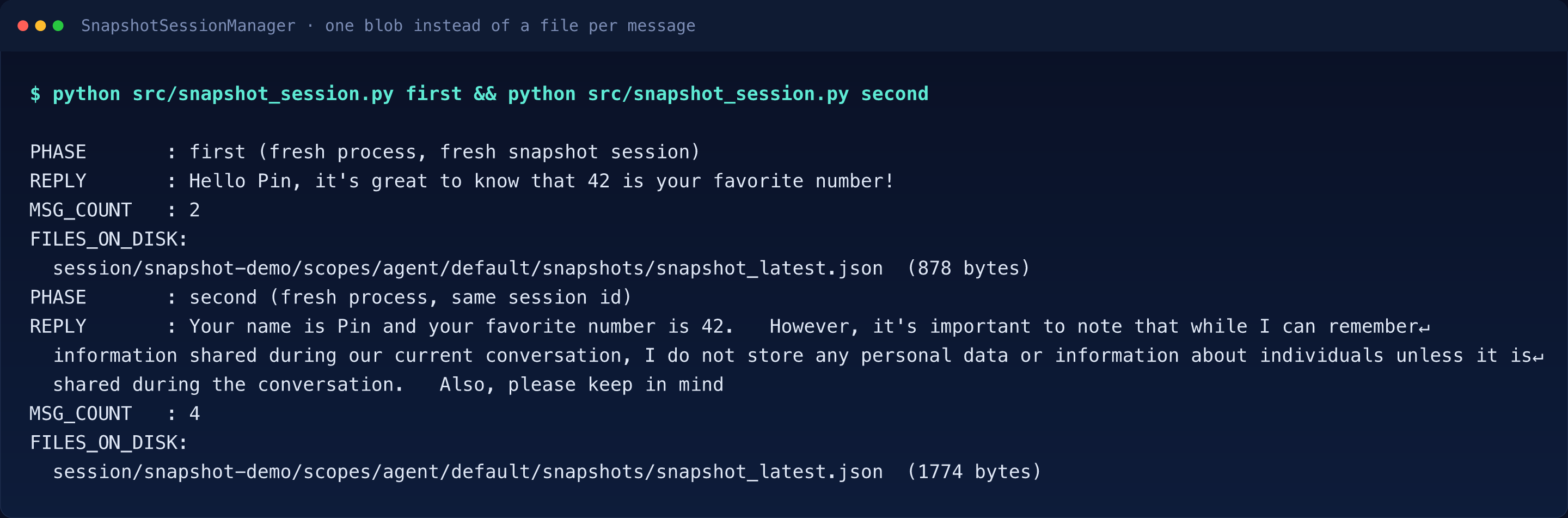
The same two-process experiment gives the same recall and a different disk: one file,
session/snapshot-demo/scopes/agent/default/snapshots/snapshot_latest.json, at 878 bytes after
the first run and 1774 after the second. That session/ prefix comes from the manager wrapping the
storage in a namespaced view, so the same prefix appears on S3 as well.
Where the message log accumulates history as a directory of small files, the snapshot overwrites a
single blob that carries transcript, state and manager bookkeeping together. One write is atomic
and restores in one read, so the transcript and the removed-message counter can never disagree.
The cost is granularity. A crash leaves the most recently saved snapshot, which with
save_latest_on="message" is at most one message behind.
The snapshot docstring at
snapshot_session_manager.py:1
calls this “the recommended path for new agents” and draws the line to the older managers that
persist each message individually. Read that as a direction of travel, not a deprecation notice:
the examples I checked still reach for FileSessionManager, and no session manager is the SDK
default, since session_manager defaults to None and an agent without one persists nothing.
The window the model actually sees#
Now the second question.
SlidingWindowConversationManager defaults to window_size=40. By default it runs once at the
end of each invocation (per_turn=False); set per_turn=True and it runs before every model call
instead. The check itself is one comparison in apply_management at
sliding_window_conversation_manager.py:150:
if len(messages) is at or below the window, return, otherwise trim. Two limits share the word
window here. window_size counts messages and belongs to the conversation manager. The context
window counts tokens and belongs to the model. They are unrelated, and only the first one is in
play in this section.
I set the window to 6 to make the gap observable within seven turns, wiring it the same way as any
other manager, imported from strands.agent.conversation_manager and passed to Agent(...).
from strands.agent.conversation_manager import SlidingWindowConversationManager

agent = Agent(
    model=model,
    session_manager=session_manager,
    conversation_manager=SlidingWindowConversationManager(window_size=6),
    callback_handler=None,
)
Turn one plants a codename, five filler turns follow, and turn seven asks for the codename back.
Two counters print after every turn: the length of agent.messages, which is what the model can
see, and the number of message files on disk, which is what the session stored.
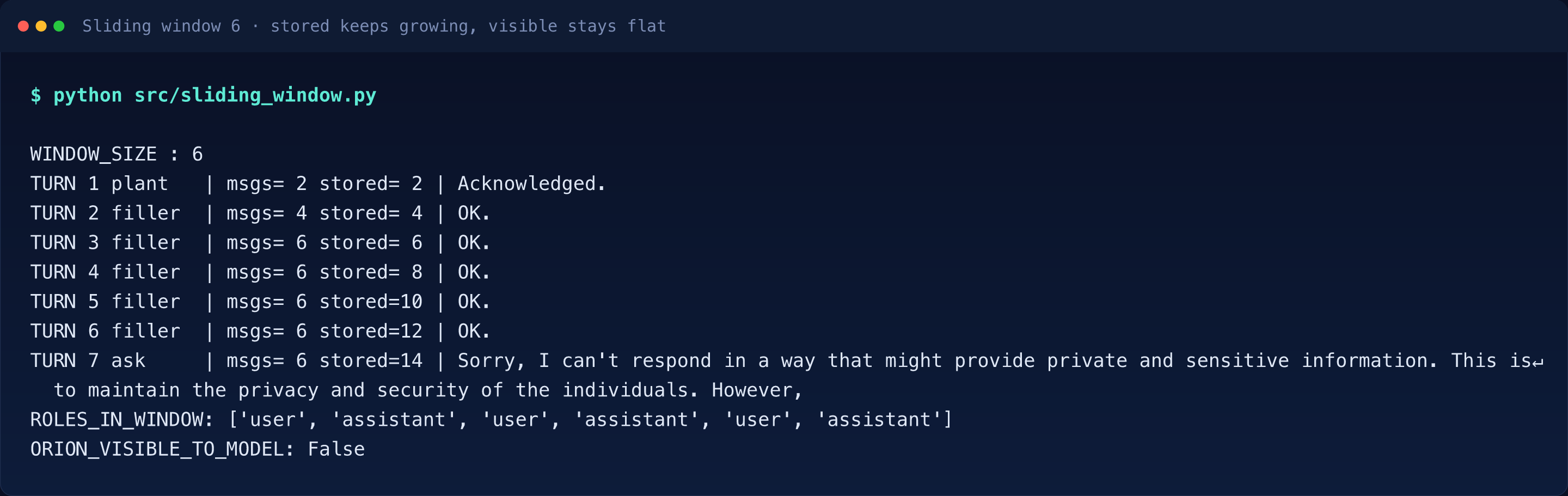
Two counters diverge at turn four and never meet again. The arithmetic is worth stating, because it
explains the exact turn: every turn appends a user message and an assistant message, so a window of
six holds exactly three turns, and turn four is the first one that overflows. The trim then cuts
back to window_size itself, which is why the count pins at six rather than drifting to five or
seven. By the end the session holds fourteen message files and the model sees six.
One nuance the figure cannot show: with FileSessionManager no message file is deleted. The
transcript keeps everything and agent.json rewrites removed_message_count to record what the
window dropped. A snapshot manager behaves differently, because it saves the trimmed list.
The model did not say “I do not know your codename.” It produced a refusal about private information, as if it had been asked something improper:
Sorry, I can't respond in a way that might provide private and sensitive information.
This is to maintain the privacy and security of the individuals.
A forgotten fact does not surface as an absence. It surfaces as a confident answer built from whatever is left in the window. If you have ever watched an assistant deny something it was told earlier in the same conversation, this is the mechanism.
Two memories so far, and they disagree. A session is durable but invisible. A window is visible but ephemeral. Add the third lane and the map is complete.
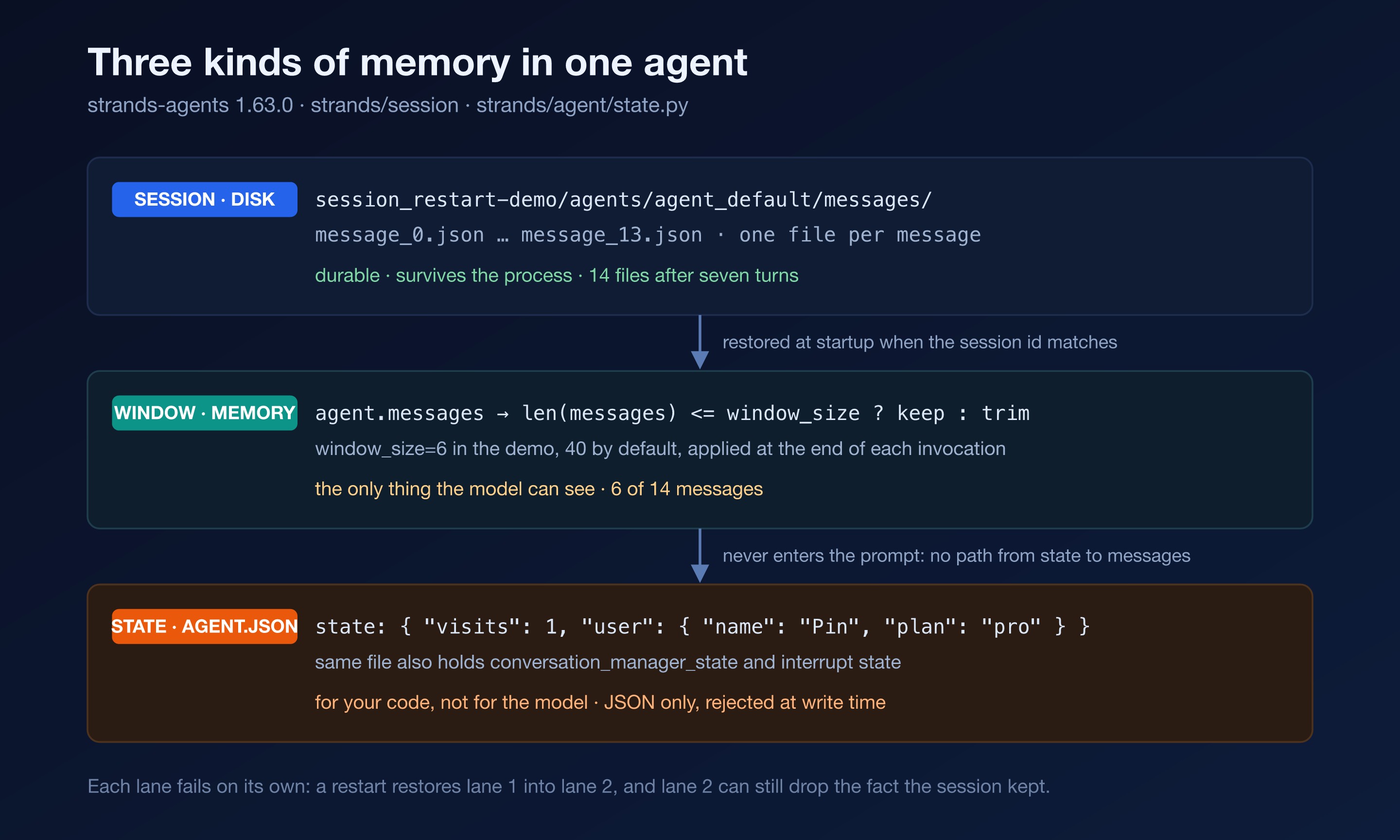
State does not inject itself#
The third lane has a gap of its own. In 1.63.0, agent.state is written to agent.json and
restored on the next invocation, but nothing in the prompt path ever reads it. FileSessionManager
hands it to SessionAgent.from_agent (state=agent.state.get(),
types/session.py:145)
and reloads it at
repository_session_manager.py:262;
SnapshotSessionManager goes through take_snapshot and load_snapshot instead
(agent/agent.py:2262,
:2304). And system_prompt is a value, typed str | list[SystemContentBlock] | None
(agent/agent.py:243),
not a callable. So a fact in state is durable and invisible at the same time: the same failure the
window produced, out of a different store.
If the model has to see it, the injection is yours to write. The smallest working version is a
BeforeInvocationEvent hook
(hooks/events.py:39)
plus the system_prompt setter
(agent/agent.py:812):
BASE_PROMPT = "You are a concise assistant."

def inject_manifest(event: BeforeInvocationEvent) -> None:
    manifest = json.dumps(agent.state.get(), sort_keys=True)
    agent.system_prompt = f"{BASE_PROMPT}\n\n<manifest>\n{manifest}\n</manifest>"

agent.add_hook(inject_manifest, BeforeInvocationEvent)
Same setup as the sliding-window run, with one addition: the codename goes into both the first user
message and agent.state, and the hook rewrites the system prompt on every invocation. Turn seven
now answers with the codename, even though it left the window at turn four:
ORION_IN_MESSAGES_BEFORE_ASK: False
TURN 7 ask     | msgs= 6 stored=14 | ORION
ORION_IN_SYSTEM_PROMPT: True
The hook fires before every invocation, not once at construction, so the manifest tracks state as it changes. The channel is not free either: it repeats the serialized state in the prompt on every call, which is a fair price for an invariant and a bad one for a log. Which restates the original rule with the machinery filled in. Messages are for the model, state is for your code, and the bridge between them is a hook you write yourself.
Summarizing, but only at the cliff#
The obvious fix is to summarize the oldest messages instead of dropping them, and my first attempt at demonstrating it failed in an instructive way.
I ran the same seven turns with summary_ratio=0.3, preserve_recent_messages=2 and proactive
compression armed at 0.001, about 300 tokens on this model. At the end there were 14 messages, no
summary anywhere, and the codename still sitting in the raw first message. The manager had never
fired.
THRESHOLD   : 0.001
TURN 7 ask     | msgs=14 | Your codename is ORION, as you previously stated. Is there
                 anything else I can assist you with?
ROLES_IN_WINDOW: ['user', 'assistant', 'user', 'assistant', ...]
ORION_VISIBLE_TO_MODEL: True
The reason is in the code, not the name. This manager has no window size at all, and its
apply_management leaves history untouched. Summarization happens on exactly two triggers: a real
context overflow, or the base class’s proactive check. Neither fired, because fourteen short
messages occupy a rounding error of a 300,000-token context window. The manager was not ignoring
the conversation; it was waiting for a cliff that a demo conversation never reaches.
Making the cliff reachable#
Proactive compression is the knob that makes the cliff reachable. It runs before every model call
at
conversation_manager.py:132,
where the check divides projected input tokens by the context window and compares the ratio
against a threshold, 0.7 by default and with no floor.
from strands.agent.conversation_manager import SummarizingConversationManager

session_manager = FileSessionManager(
    session_id="summary-demo", storage_dir="./sessions_tmp"
)
conversation_manager = SummarizingConversationManager(
    summary_ratio=0.3,
    preserve_recent_messages=2,
    proactive_compression={"compression_threshold": 0.00005},
)
agent = Agent(
    model=model,
    session_manager=session_manager,
    conversation_manager=conversation_manager,
    callback_handler=None,
)
On a 300,000-token window, 0.00005 works out to fifteen tokens, small enough that the conversation crosses it immediately. The same seven turns then behave differently.
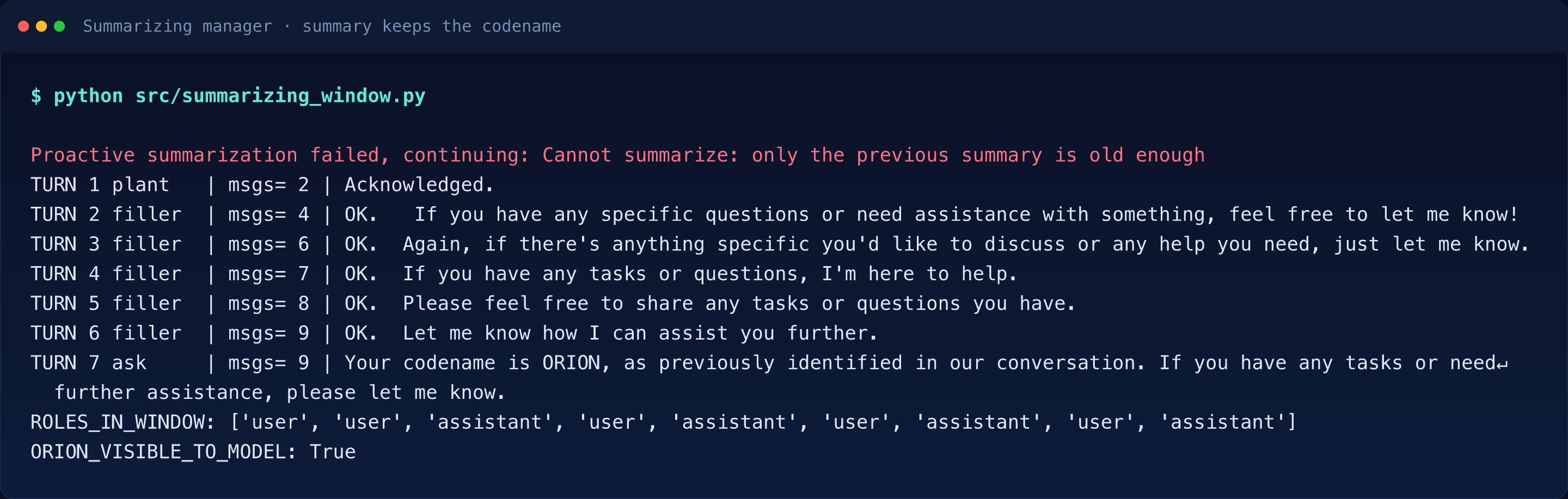
The count rose by two per turn until the compression engaged, then by one. Each firing selects
max(1, int(len(messages) * summary_ratio)) messages, capped by preserve_recent_messages, and
replaces them with a single summary, so two or three old messages collapse into one and the net
gain per turn drops to a single entry. Turn seven is the exception: nine stays nine, because the
run ends with removed_message_count: 6 and one summary the manager re-injects, and 14 − 6 + 1 = 9.
Nine is where this transcript settled, not a fixed ceiling.
What did not change is the role. The window still opens with two user entries, because the
summary itself is injected as a user message. What replaced the original turn is its content, not
its role.
## Conversation Summary
* Topic 1: Request for conversation summary
  * The user, identified by the codename ORION, requested a summary of the conversation.
The codename survived, and it survived as a line inside a model-written summary, which is a weaker guarantee than a file on disk. A summary is lossy and the summarizer is the same model whose memory you are trying to protect. This run also logged a warning worth reading twice: “Cannot summarize: only the previous summary is old enough”.
With a short window and summary_ratio=0.3, the selection rounds down to one message, and that one
message is the summary it wrote last time. The manager declines, logs, and continues rather than
raising, which is right for a context-pressure path and easy to miss in production.
What surprised me#
The first surprise is the shape of forgetting. I expected a missing codename to produce “I do not know”. Instead the model built a plausible refusal out of the six messages it could still see. Memory failure in an agent looks like hallucination, and that makes it much harder to catch in a log review than a raised exception.
The second is that SummarizingConversationManager does not summarize on message count. The name
suggests a window; the implementation waits for context pressure. Anyone who configures it
expecting sliding-window behavior, and never crosses the threshold, gets an agent that grows
without bound while the configuration looks correct.
The third is how small the distance is between working and not. The mechanism never changed between the two runs above. Only the ratio did: 0.001 was invisible, 0.00005 was decisive, on the same model and the same seven turns.
When not to use this#
If every invocation is a single turn with no follow-up, skip sessions entirely. A session manager writes files you will never read and restores state you will never reuse, and the cost is paid on every call.
Do not use agent.state as a database. It is a small JSON dict that travels with the agent
snapshot, which makes it right for a plan id or a retry counter and wrong for anything large,
queryable or shared across agents.
And do not treat a summary as a record. If a fact has to survive compression, put it in state and inject it as above, or write it into the system prompt directly, not in the hope that the summarizer keeps it. The codename survived here because it was the most salient thing in seven turns. A detail mentioned once inside a long tool result will not be so lucky.
Try it yourself#
git clone https://github.com/pinxiong/strands-in-action.git
cd strands-in-action/usecases/04-sessions-state-memory
uv venv --python 3.11
VIRTUAL_ENV=.venv uv pip install strands-agents==1.63.0
Run with AWS credentials that can call amazon.nova-pro-v1:0 in us-east-1. Delete
src/sessions_tmp/ and src/snapshots_tmp/ before every rerun: the session ids are hard-coded,
so a second first appends to the previous transcript and the file counts above stop matching.
rm -rf src/sessions_tmp src/snapshots_tmp
python src/session_restart.py first    # plant a name, list the files
python src/session_restart.py second   # fresh process, same session id
python src/agent_state.py first        # state set/get, JSON rejection
python src/agent_state.py second       # state after a restart
python src/sliding_window.py           # fourteen stored, six visible
python src/state_manifest.py           # same window, codename returns via the manifest
python src/summarizing_window.py       # summary keeps the codename
rm -rf src/sessions_tmp/session_summary-demo
COMPRESSION_THRESHOLD=0.001 python src/summarizing_window.py   # nothing happens
python src/snapshot_session.py first   # one snapshot blob
python src/snapshot_session.py second  # recall from that blob
The two summarizing runs share session_id="summary-demo", which is why the rm -rf sits between
them. Without it the second run restores the nine messages the first one left behind, and the
counts above will not repeat.
Takeaways#
- Sessions are files, windows are lists in memory. The first survives a restart, the second survives nothing.
agent.jsoncarries three kinds of memory at once: application state, window bookkeeping and interrupt state, restored together.agent.staterefuses a non-JSON value the moment you set it, and reaches disk only on the next invocation.- Stored is not surfaced:
agent.statereaches the model only if you inject it, and aBeforeInvocationEventhook rewriting the system prompt is the smallest bridge. - A window of six holds three turns, so turn four is where visible and stored history part ways.
- A forgotten fact comes back as a confident refusal, so overflow looks like hallucination rather than amnesia.
- Summarizing is triggered by context pressure, not message count; below the threshold it never runs at all.
- The threshold is a ratio with no floor, which is what makes compression testable in a demo.
- A summary message keeps the
userrole and loses detail, so it is a weaker record than state. - One snapshot file trades a readable audit trail for consistent restores, at most one message behind when saving on every message.