Four protocols walk into one project. An orchestrator that speaks AG-UI streams
its answers as server-sent events, two specialists answer A2A tasks — one of
them for 115 seconds past any synchronous read timeout — and a billing tool
server answers MCP calls on EC2 instance types I chose myself. On top of the
fleet sits a catalog: the Agent Registry, shared across accounts through RAM,
whose semantic search finds the record named billing when asked for payment
processing. Every number below was measured in one account, us-east-1.
The use case#
Northwind Gear’s legal desk reviews supplier contracts. Two jobs keep the lawyers busy: a clause-by-clause read against the house wording, and a compliance screen that escalates anything policy-breaking. A contract-review orchestrator receives the brief and farms each job out to a specialist agent, because the two teams refuse to share a prompt, a model version, or a release schedule. Finance, meanwhile, wants one place where every agent and every MCP server the company runs is registered and findable — including from the shared services account — without asking engineering for a spreadsheet.
What AgentCore does here#
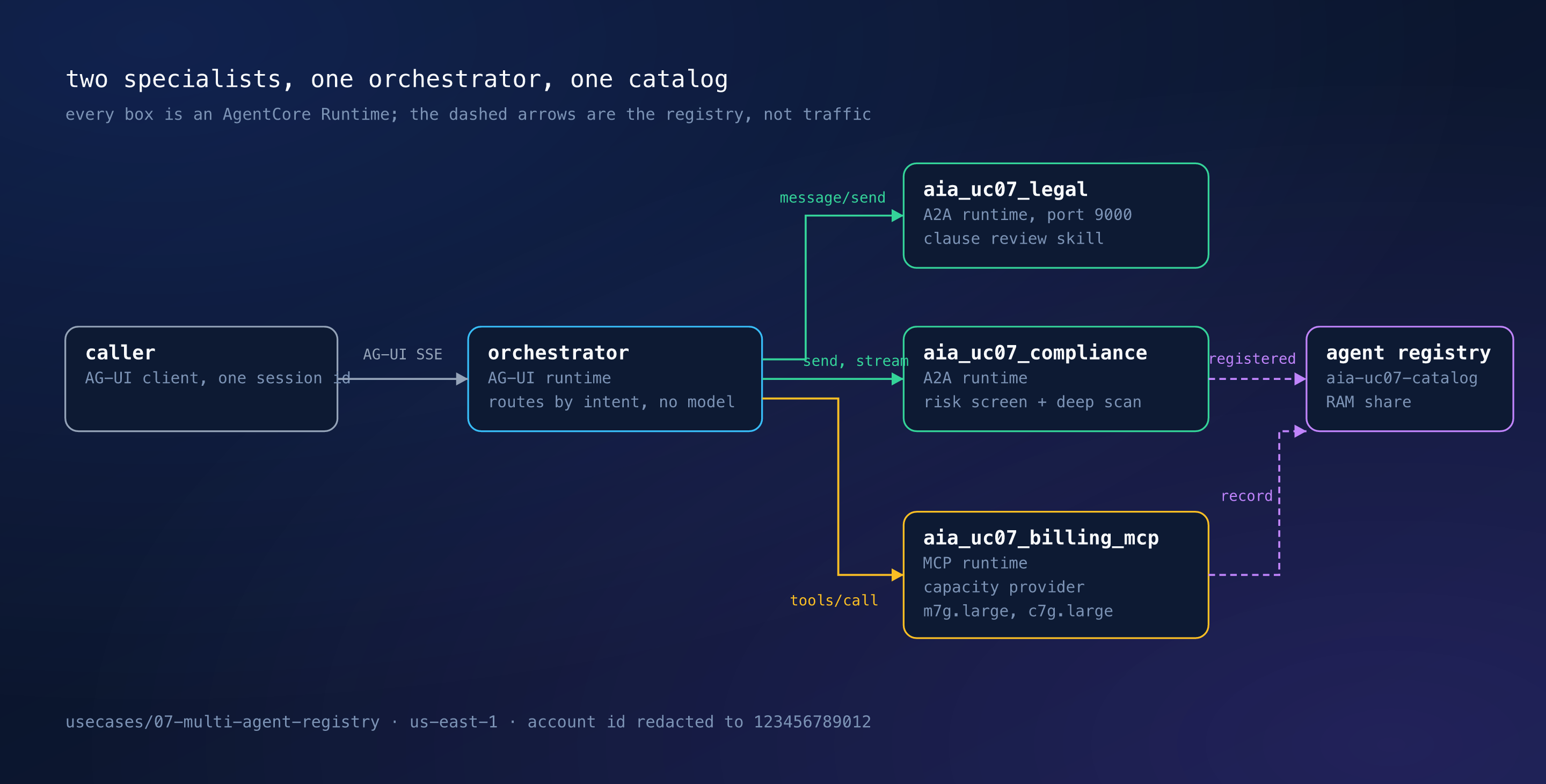
- Runtime hosts four agents, one per protocol: AG-UI for the orchestrator, A2A for the legal and compliance specialists, MCP for the billing tool server.
- A2A protocol carries the specialist traffic: blocking
message/sendfor the quick review, non-blocking accept plus polling for the long scan, andmessage/streamwithtasks/cancelfor barge-in. - AG-UI protocol is what the caller sees: the orchestrator streams RunStarted, text chunks and RunFinished as SSE.
- MCP server hosting runs a FastMCP server as a runtime, so tools/call is a managed, authenticated invocation like any other.
- Long-running async: the deep scan accepts at 0.0 seconds and completes at 115.0 seconds, while a blocking request for the same work dies in the client’s own read timeout at 184.9 seconds.
- Session isolation: ten sessions on one runtime each get their own microVM; ten codewords stored and recalled with zero cross-talk.
- Custom EC2 instance types: a capacity provider pins the billing server to
m7g.largeandc7g.largeinstances instead of the serverless default. - Registry plus RAM: the catalog holds two records, search resolves natural language to records, and the registry itself is a RAM-shareable resource.
Requirements#
- Node.js 20 or newer, the AgentCore CLI 0.31.1, AWS CLI 2.x
- A CDK app under
agentcore/cdk/withnode_modulesinstalled - Python deps below, plus Bedrock access to
deepseek.v3.2 - Region
us-east-1for everything; a default VPC for the capacity provider - Session ids of at least 33 characters
The code#
https://github.com/pinxiong/bedrock-agentcore-in-action/tree/master/usecases/07-multi-agent-registry
app/aia_uc07/orchestrator.py— the AG-UI endpoint and a deterministic router: no model, just intents, so the protocol layer is what gets measuredapp/aia_uc07/legal_agent.pyandcompliance_agent.py— the specialists, each wrapped inStrandsA2AExecutorand served withserve_a2aon port 9000app/aia_uc07/billing_mcp.py— a FastMCP server with three tools and no modelapp/aia_uc07/a2a_client.py— discovery (ListAgentRuntimes,GetAgentCard) and SigV4-signed A2A JSON-RPC: send, stream, get, cancelapp/aia_uc07/policies/orchestrator-policy.json— the extra IAM the orchestrator needs, attached throughadditionalPoliciesin the contractagentcore/agentcore.json— four runtimes plus the capacity providerevidence/— the captured output this article shows
How it works#
The orchestrator is the front door. It speaks AG-UI, so a caller posts one RunAgentInput and receives SSE events back:
{
  "threadId": "uc07-demo",
  "runId": "r1",
  "messages": [{"id": "m1", "role": "user", "content": "review contract C-118"}],
  "tools": [],
  "context": [],
  "state": {},
  "forwardedProps": {}
}
Inside, the router has no model — the point of the use case is the wiring, so
intents map straight to A2A calls. It discovers the specialists at runtime
with ListAgentRuntimes, matching on the suffix of each deployed name,
because the deploy stamps the project prefix in front of every runtime
(aiauc07_aia_uc07_legal), then fetches each agent card with GetAgentCard
before sending. One IAM line makes this legal: the orchestrator’s role allows
bedrock-agentcore:ListAgentRuntimes and bedrock-agentcore:GetAgentCard.
The list and the card are the discovery contract:
aws bedrock-agentcore-control list-agent-runtimes --region us-east-1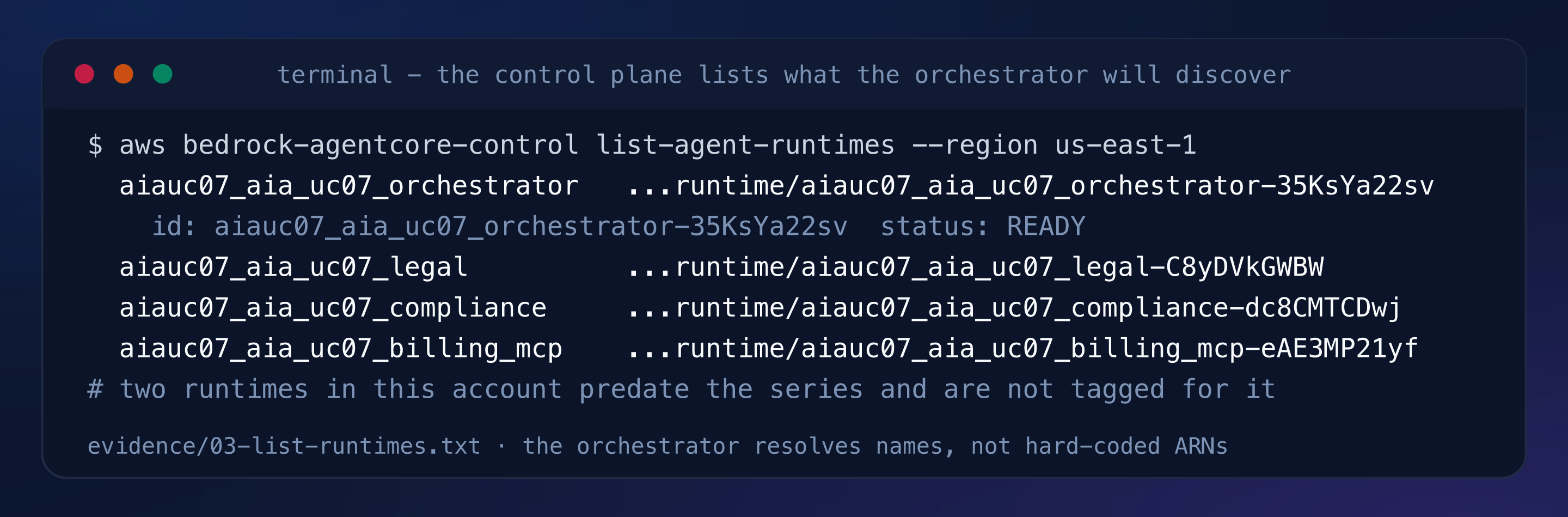
aws bedrock-agentcore get-agent-card --region us-east-1 \
  --agent-runtime-arn arn:aws:bedrock-agentcore:us-east-1:123456789012:runtime/aiauc07_aia_uc07_legal-C8yDVkGWBW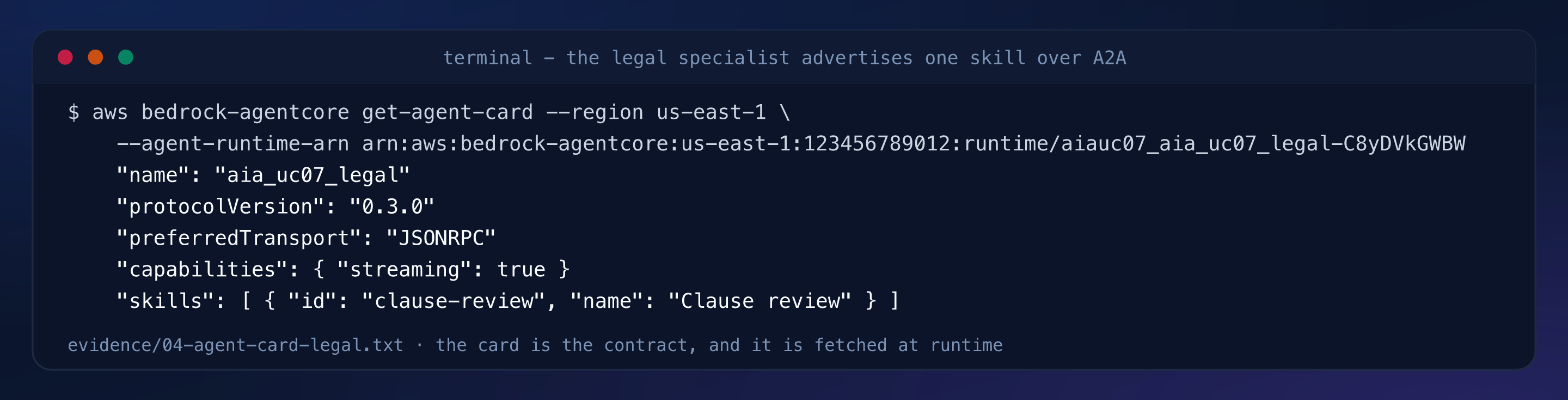
The A2A wire then forks by shape of work. The review is two blocking
message/send calls; each returns a completed task with the specialist’s
answer. The deep scan is a five-pass, 75-second job, so it is dispatched with
blocking: false — the server answers immediately with a submitted task, and
the orchestrator polls tasks/get until the state flips. Barge-in is
message/stream for live status updates plus one tasks/cancel the moment
the first update arrives; the Strands executor cooperates and the stream
closes in state canceled.
Sessions are cheap isolation. The session id travels in the
X-Amzn-Bedrock-AgentCore-Runtime-Session-Id header, every distinct id gets
its own microVM, and state lives in a plain in-process dict — so ten
sessions storing and recalling ten codewords is a direct test of the
boundary.
The billing server is MCP: FastMCP, streamable-http, three tools, no model.
It is also the one runtime pinned to customer-managed compute. A capacity
provider declares an ARM64 pool of m7g.large and c7g.large with a
300-second idle timeout, and the runtime references it at creation. The
combination is what makes custom EC2 instance types a contract property, not
a console setting.
The registry is control-plane only. Records carry descriptors — the MCP
server’s descriptor is a minimal document against schema 2025-12-11 — and a
record walks CREATING to DRAFT to PENDING_APPROVAL to APPROVED before search
will return it. Search is semantic: the query payment processing shares no
noun with the record name billing, yet billing is the first hit. RAM then
shares the registry itself, because agent-registry:Registry is a
RAM-shareable resource type.
Deploy it#
One contract, one deploy. The stack carries all four runtimes and the capacity provider:
agentcore deploy -y --target default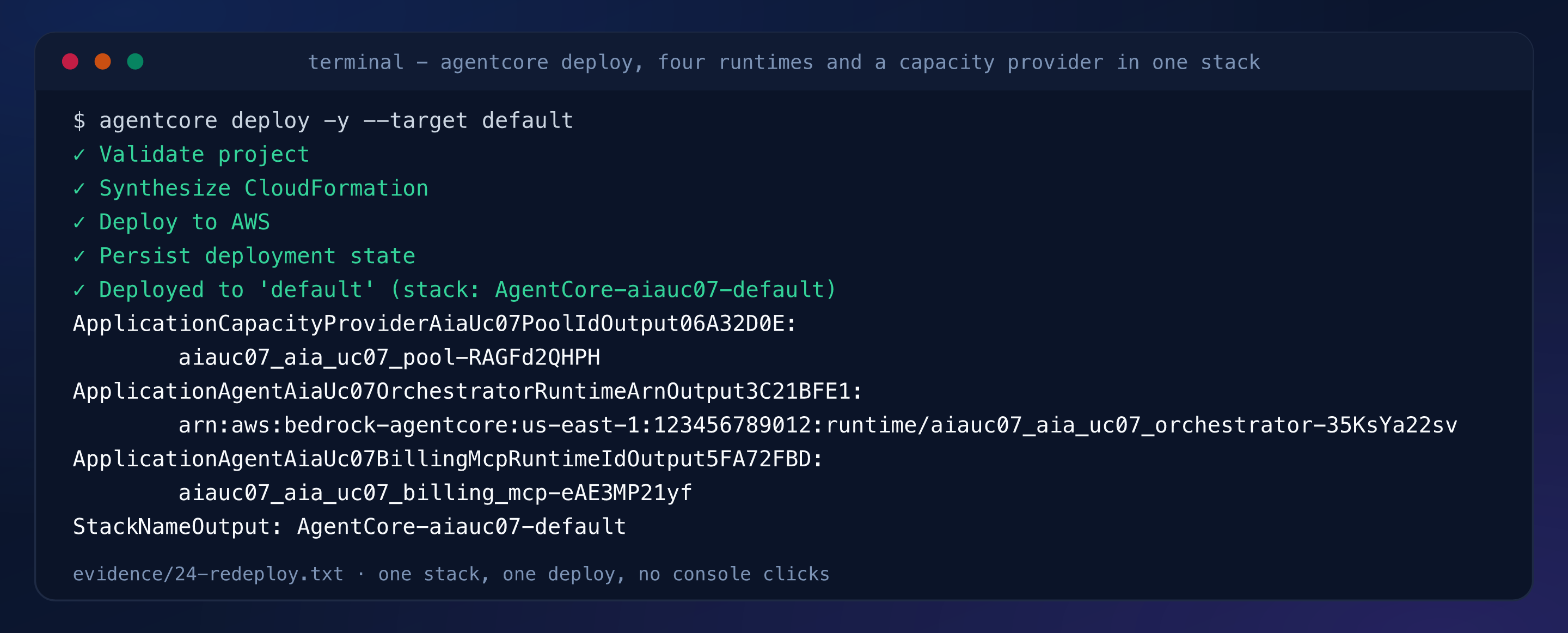
agentcore status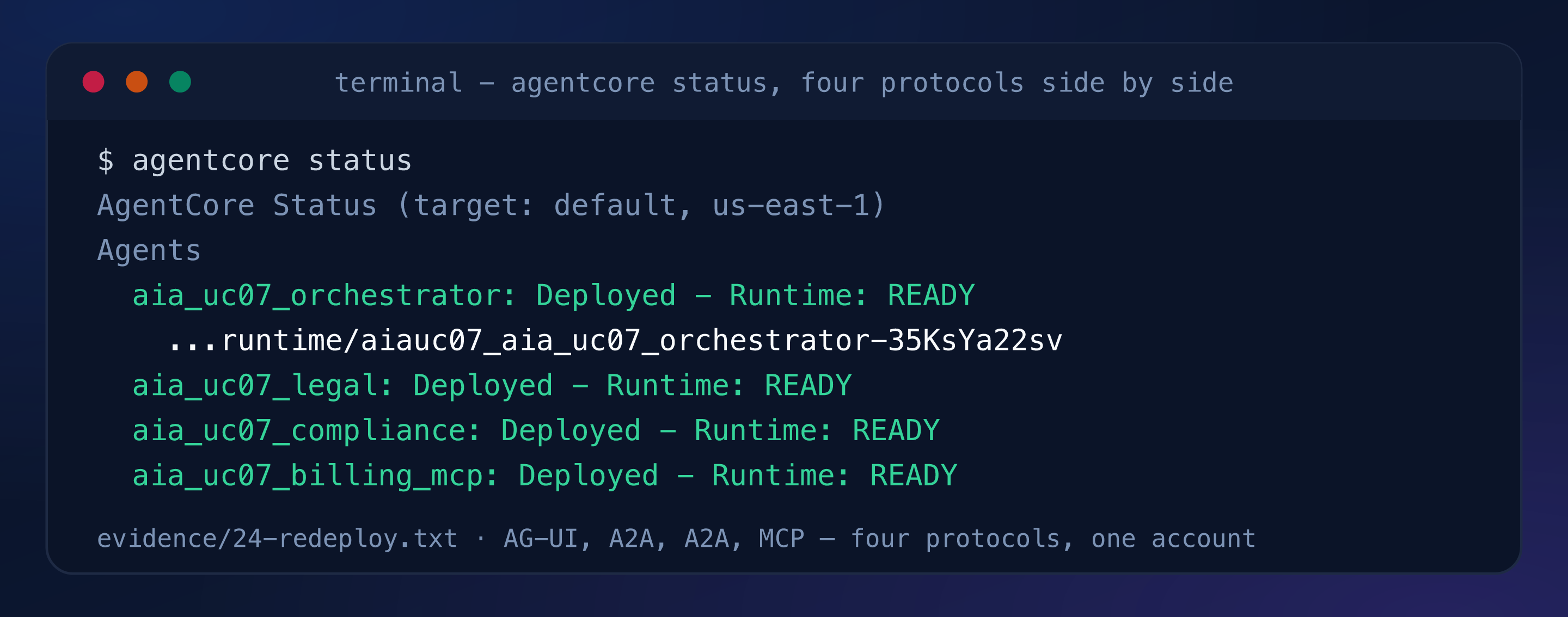
The review is the assertion that matters most — one request, two specialists, two completed A2A tasks. The orchestrator resolves both ARNs by discovery, fetches the card, and the legal and compliance specialists each finish their task:
aws bedrock-agentcore invoke-agent-runtime --region us-east-1 \
  --agent-runtime-arn arn:aws:bedrock-agentcore:us-east-1:123456789012:runtime/aiauc07_aia_uc07_orchestrator-35KsYa22sv \
  --qualifier DEFAULT --runtime-session-id uc07-review-46702a95300245bda08060b2f73d4cda \
  --content-type application/json --accept text/event-stream \
  --payload fileb:///tmp/uc07-agui-payload.json /tmp/uc07-agui-out.bin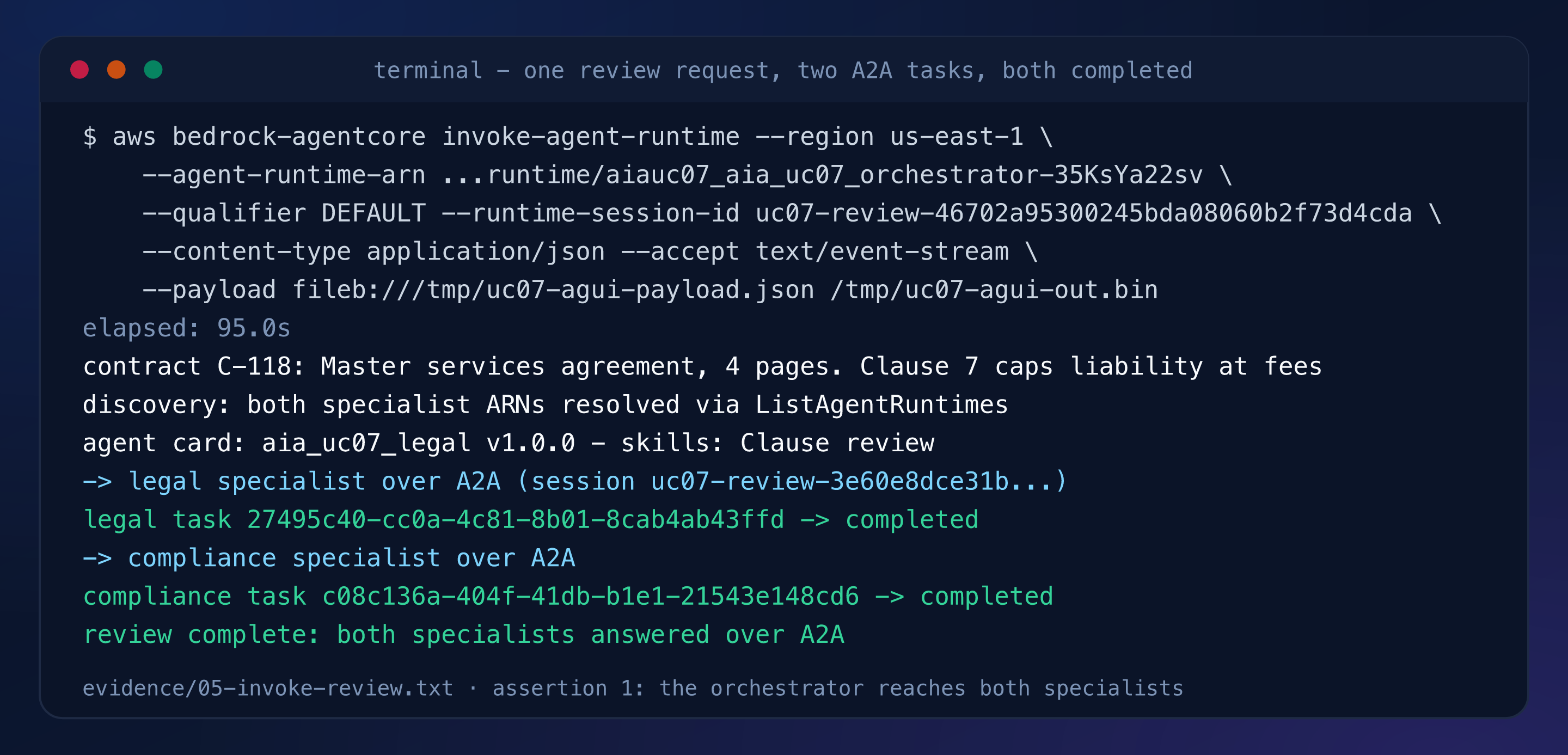
Now the long scan, dispatched non-blocking. The accept is instant; the work runs for 115 seconds — past every synchronous ceiling — and completes with a full report:
aws bedrock-agentcore invoke-agent-runtime --region us-east-1 \
  --agent-runtime-arn arn:aws:bedrock-agentcore:us-east-1:123456789012:runtime/aiauc07_aia_uc07_orchestrator-35KsYa22sv \
  --qualifier DEFAULT --runtime-session-id uc07-deepscan-<uuid> \
  --content-type application/json --accept text/event-stream \
  --payload fileb:///tmp/uc07-agui-payload.json /tmp/uc07-agui-out.bin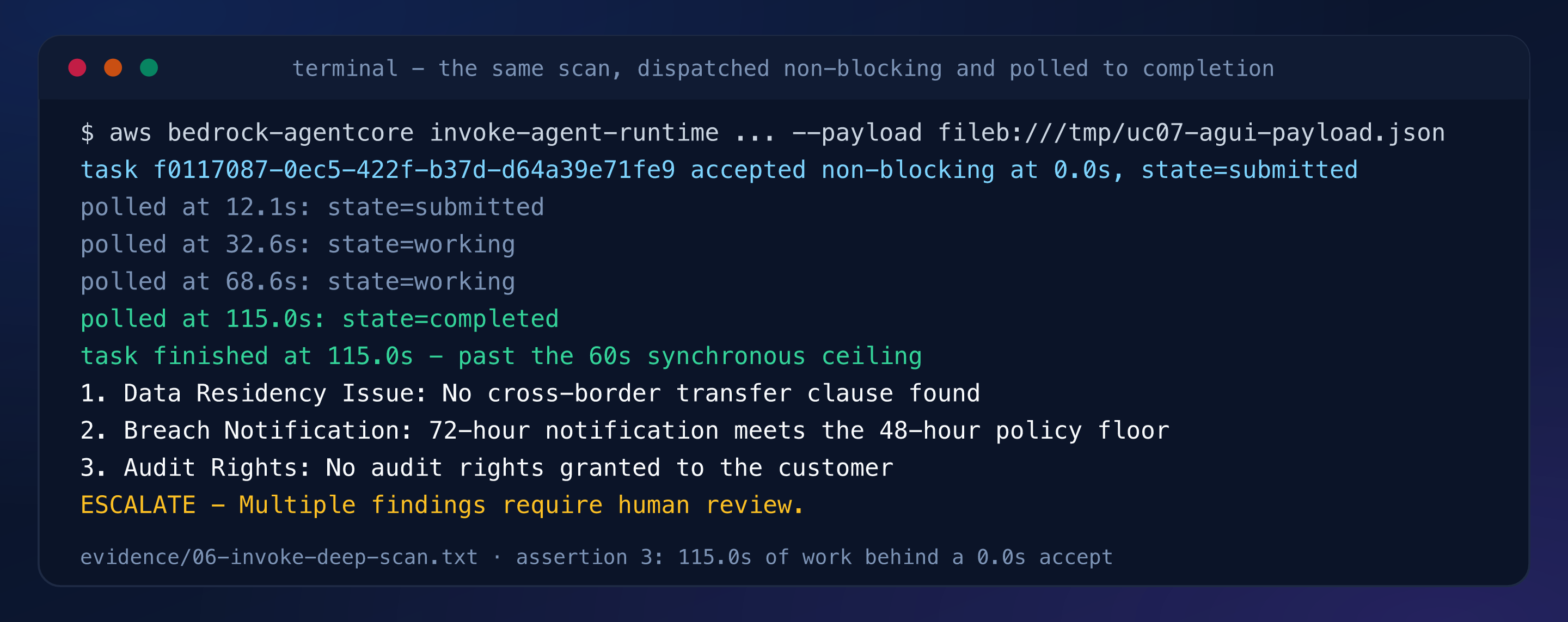
Ask for the same scan with a blocking send and a short client timeout, and the failure is the client’s, not the server’s: three SDK retry windows, then a read timeout on the endpoint URL.
aws bedrock-agentcore invoke-agent-runtime --region us-east-1 \
  --agent-runtime-arn arn:aws:bedrock-agentcore:us-east-1:123456789012:runtime/aiauc07_aia_uc07_compliance-dc8CMTCDwj \
  --qualifier DEFAULT --runtime-session-id uc07-timeout-<uuid> \
  --content-type application/json --accept application/json \
  --cli-read-timeout 60 --payload fileb:///tmp/uc07-a2a-payload.json /tmp/uc07-a2a-out.bin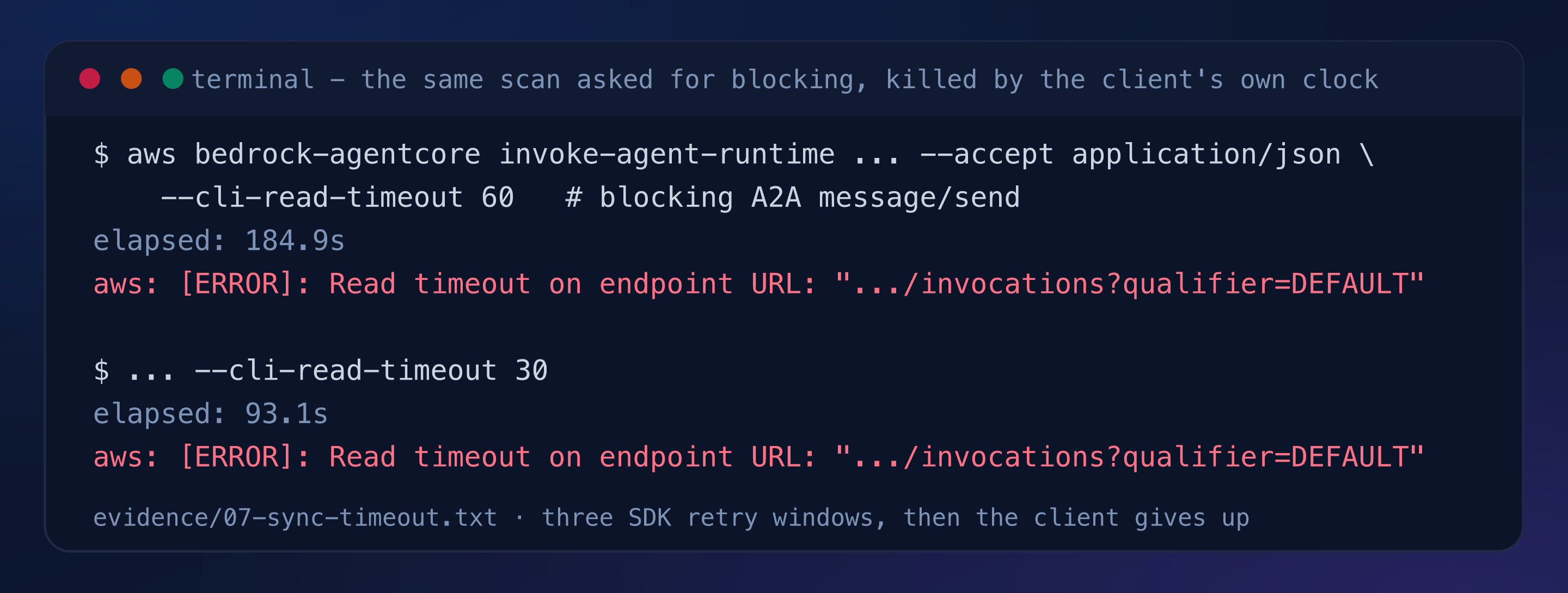
Streaming is where barge-in lives. The cancel lands on the running task and the stream closes eleven seconds in:
aws bedrock-agentcore invoke-agent-runtime --region us-east-1 \
  --agent-runtime-arn arn:aws:bedrock-agentcore:us-east-1:123456789012:runtime/aiauc07_aia_uc07_orchestrator-35KsYa22sv \
  --qualifier DEFAULT --runtime-session-id uc07-bargein-<uuid> \
  --content-type application/json --accept text/event-stream \
  --payload fileb:///tmp/uc07-agui-payload.json /tmp/uc07-agui-out.bin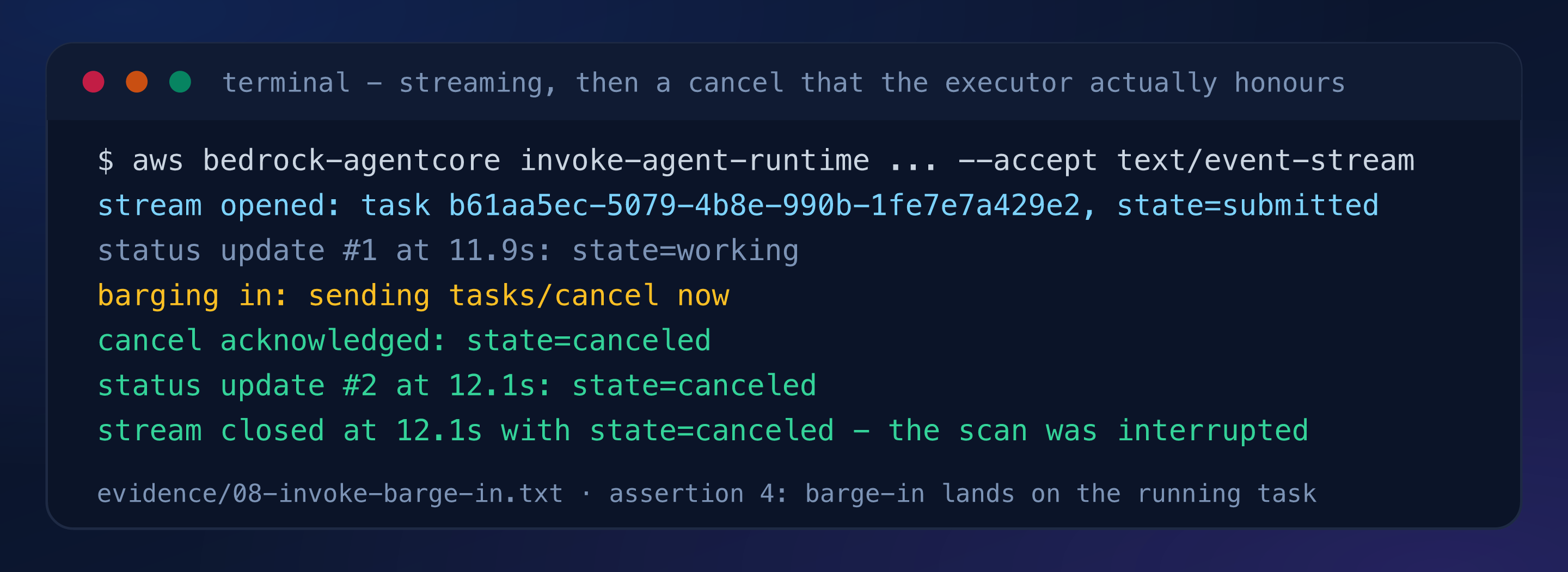
Isolation is a loop, not a claim. Ten sessions, each storing one codeword and recalling it on the same session id, twenty invocations in 88.3 seconds:
for i in 1..10; do
  aws bedrock-agentcore invoke-agent-runtime --region us-east-1 \
    --agent-runtime-arn <orchestrator-arn> --qualifier DEFAULT \
    --runtime-session-id uc07-iso-$i-<uuid> \
    --content-type application/json --accept text/event-stream \
    --payload fileb:///tmp/uc07-iso-payload.json /tmp/uc07-iso-out.bin
done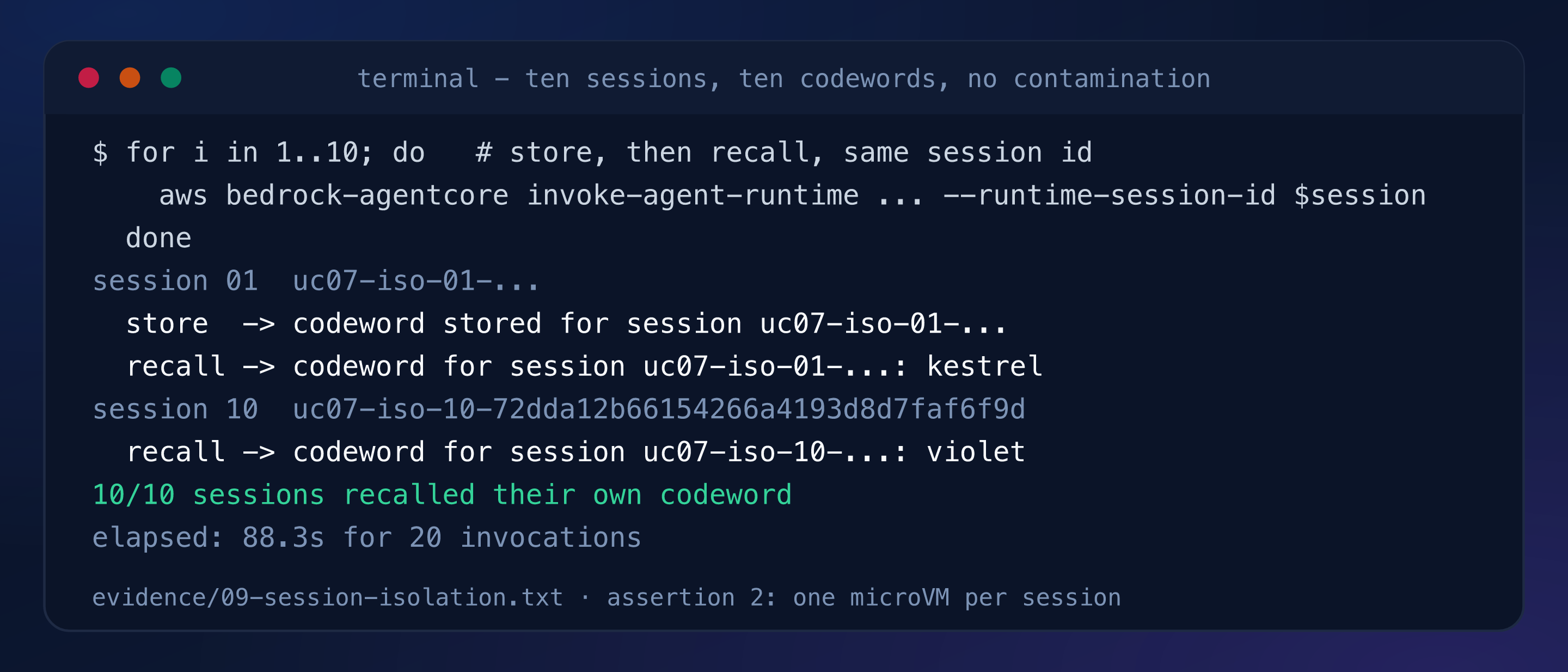
The billing server answers tools, not prompts:
agentcore invoke --runtime aia_uc07_billing_mcp call-tool \
  --tool lookup_invoice --input '{"invoice_id":"INV-2041"}'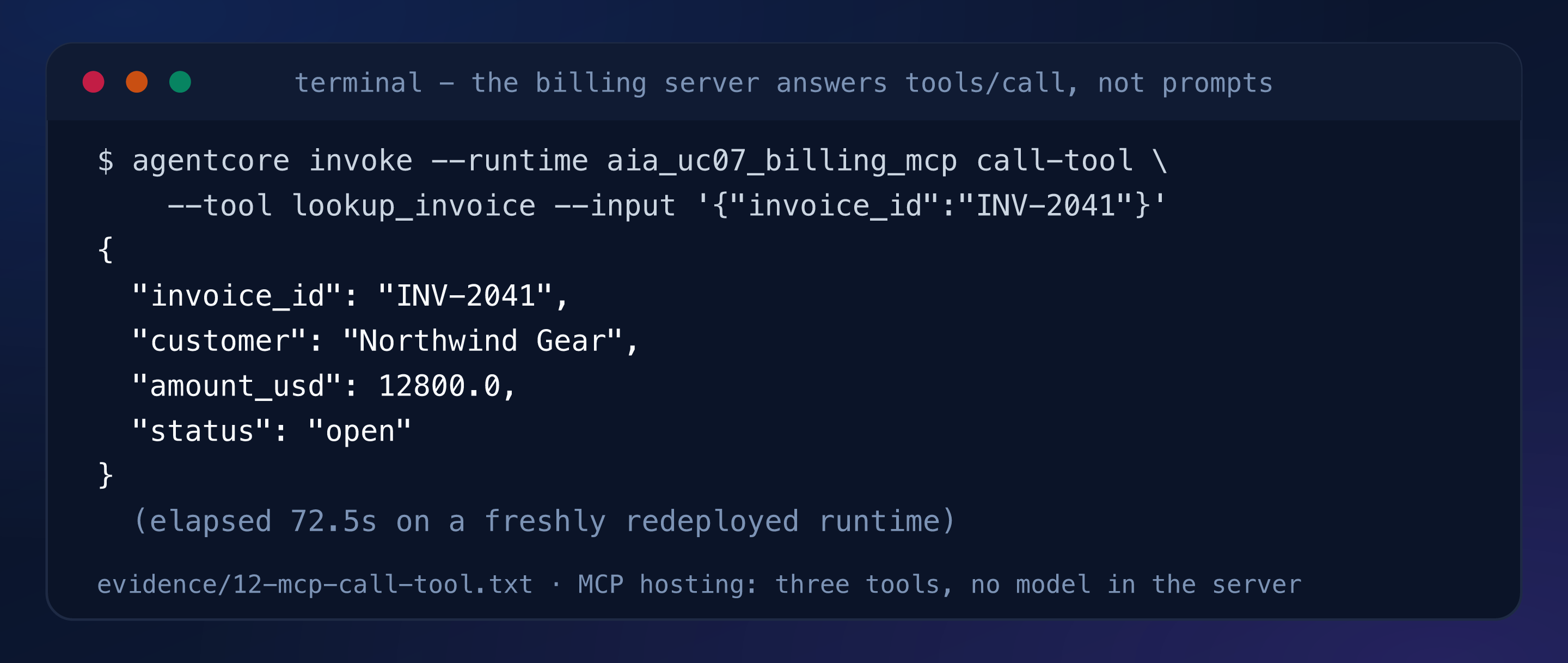
That same runtime is the one riding the capacity provider. The describe calls show both halves of the wiring:
aws bedrock-agentcore-control get-capacity-provider --region us-east-1 \
  --capacity-provider-id aiauc07_aia_uc07_pool-RAGFd2QHPH
aws bedrock-agentcore-control get-agent-runtime --region us-east-1 \
  --agent-runtime-id aiauc07_aia_uc07_billing_mcp-eAE3MP21yf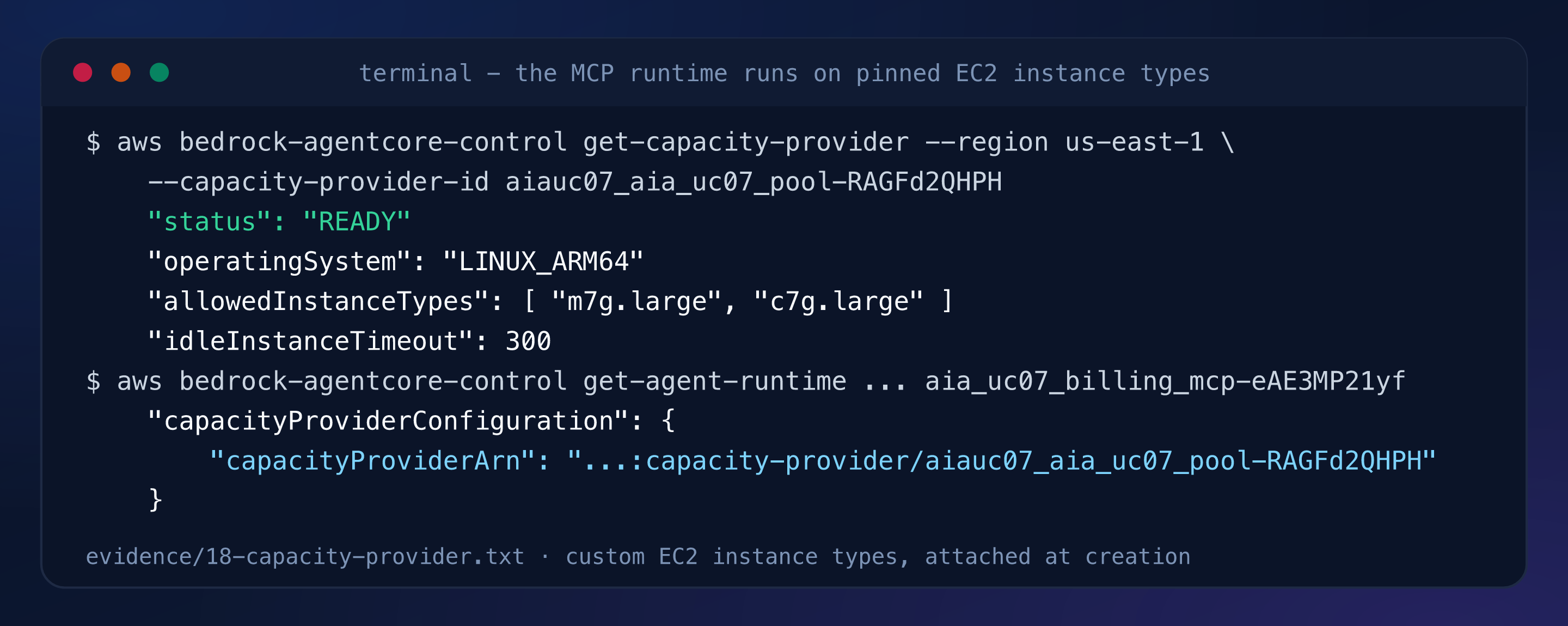
The stack does not create the catalog. The registry, its records and the RAM
share are control-plane resources the CLI contract does not model, so they
are created with the AWS CLI: the registry first, then one record per
capability. The MCP record’s descriptor is the minimal 2025-12-11 document
and the agent record carries the full A2A card:
aws agent-registry-control create-registry --region us-east-1 \
  --name aia-uc07-catalog \
  --description "Legal and compliance workflow-automation agents: contract review orchestrator, specialists and the billing MCP server" \
  --discovery-configuration authorizerType=AWS_IAM \
  --tags Project=agentcore-in-action,UseCase=07,AutoDelete=true
aws agent-registry-control create-registry-record --region us-east-1 \
  --registry-id niFvetsCk7ujKrAO --name billing --display-name "Billing MCP server" \
  --description "Invoice lookup, payment processing and refund policy tools for agents, hosted on AgentCore Runtime as a streamable-http MCP server" \
  --record-type MCP \
  --descriptors '{"mcpServer":{"data":"{\"name\": \"dev.xiongpin/billing\", \"description\": \"Billing and payment processing MCP server: invoice lookup, payment status, refunds\", \"version\": \"1.0.0\"}","dataSchemaVersion":"2025-12-11"}}' \
  --tags Project=agentcore-in-action,UseCase=07,AutoDelete=true
aws agent-registry-control create-registry-record --region us-east-1 \
  --registry-id niFvetsCk7ujKrAO --name contract-clause-legal-specialist --display-name "Legal clause specialist (A2A)" \
  --description "A2A agent that reviews contract clauses against the legal reference clause library: liability, termination, payment, confidentiality and subcontracting" \
  --record-type AGENT \
  --descriptors '{"a2aAgentCard":{"data":"{\"capabilities\": {\"streaming\": true}, \"defaultInputModes\": [\"text\"], \"defaultOutputModes\": [\"text\"], \"description\": \"Contract clause specialist: compares clauses against the reference library\", \"name\": \"aia_uc07_legal\", \"preferredTransport\": \"JSONRPC\", \"protocolVersion\": \"0.3.0\", \"skills\": [{\"description\": \"Compare contract clauses against the reference clause library\", \"examples\": [\"Review the liability and termination clauses of this brief\"], \"id\": \"clause-review\", \"name\": \"Clause review\", \"tags\": [\"legal\", \"contract\", \"clause\"]}], \"url\": \"https://bedrock-agentcore.us-east-1.amazonaws.com/runtimes/arn%3Aaws%3Abedrock-agentcore%3Aus-east-1%3A123456789012%3Aruntime%2Faiauc07_aia_uc07_legal-C8yDVkGWBW/invocations\", \"version\": \"1.0.0\"}","dataSchemaVersion":"0.3"}}' \
  --tags Project=agentcore-in-action,UseCase=07,AutoDelete=true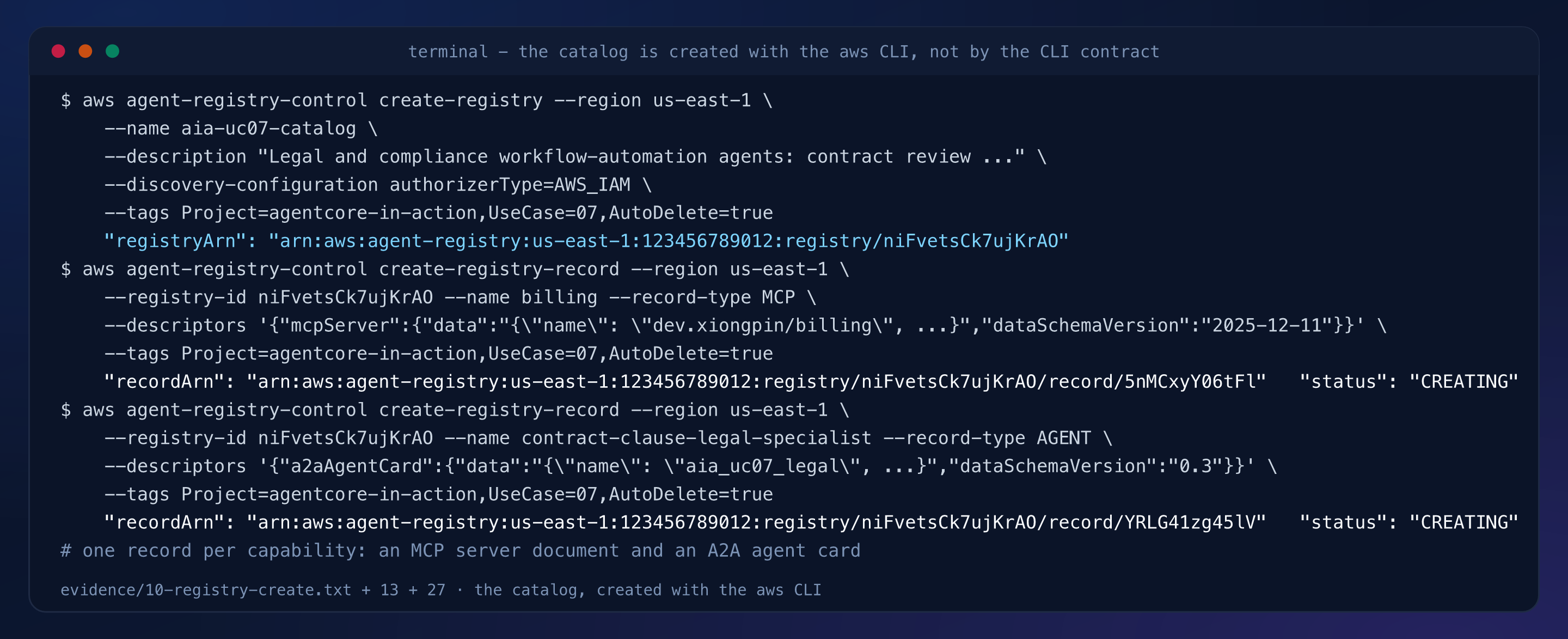
A record is not discoverable the moment it exists: it is created DRAFT, submitted for approval, and only then approved — a direct DRAFT to APPROVED call is rejected as an invalid status transition. The curation workflow, in the order the API accepts it:
aws agent-registry-control submit-registry-record-for-approval --region us-east-1 \
  --registry-id niFvetsCk7ujKrAO --record-id 5nMCxyY06tFl
aws agent-registry-control submit-registry-record-for-approval --region us-east-1 \
  --registry-id niFvetsCk7ujKrAO --record-id YRLG41zg45lV
aws agent-registry-control update-registry-record-status --region us-east-1 \
  --registry-id niFvetsCk7ujKrAO --record-id 5nMCxyY06tFl --status APPROVED \
  --status-reason "Series run: article evidence"
aws agent-registry-control update-registry-record-status --region us-east-1 \
  --registry-id niFvetsCk7ujKrAO --record-id YRLG41zg45lV --status APPROVED \
  --status-reason "Series run: article evidence"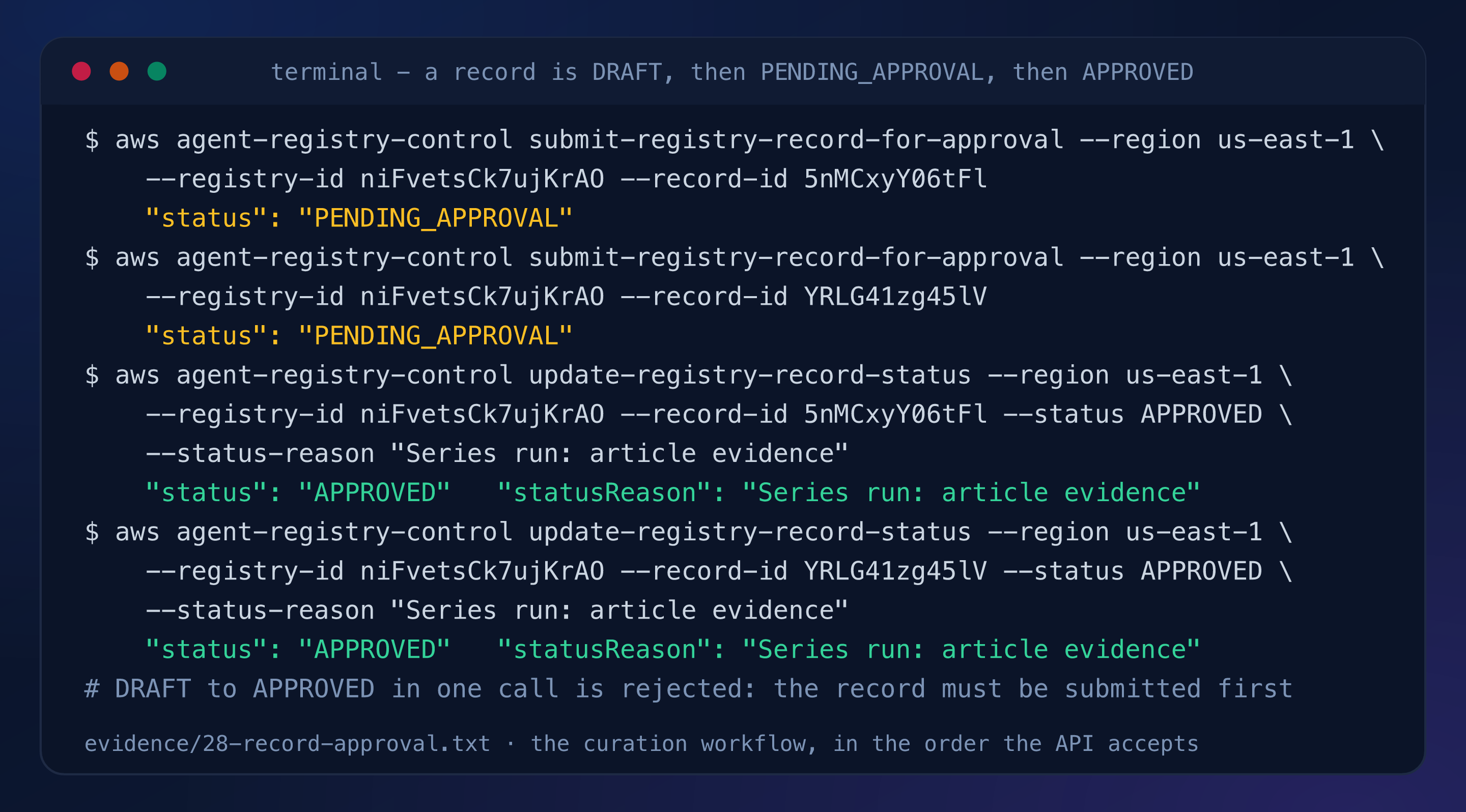
The registry itself is a RAM-shareable resource, so sharing it is one call with the registry’s ARN as the payload:
aws ram create-resource-share --region us-east-1 \
  --name aia-uc07-registry-xacct \
  --resource-arns arn:aws:agent-registry:us-east-1:123456789012:registry/niFvetsCk7ujKrAO \
  --allow-external-principals \
  --tags key=Project,value=agentcore-in-action key=UseCase,value=07 key=AutoDelete,value=true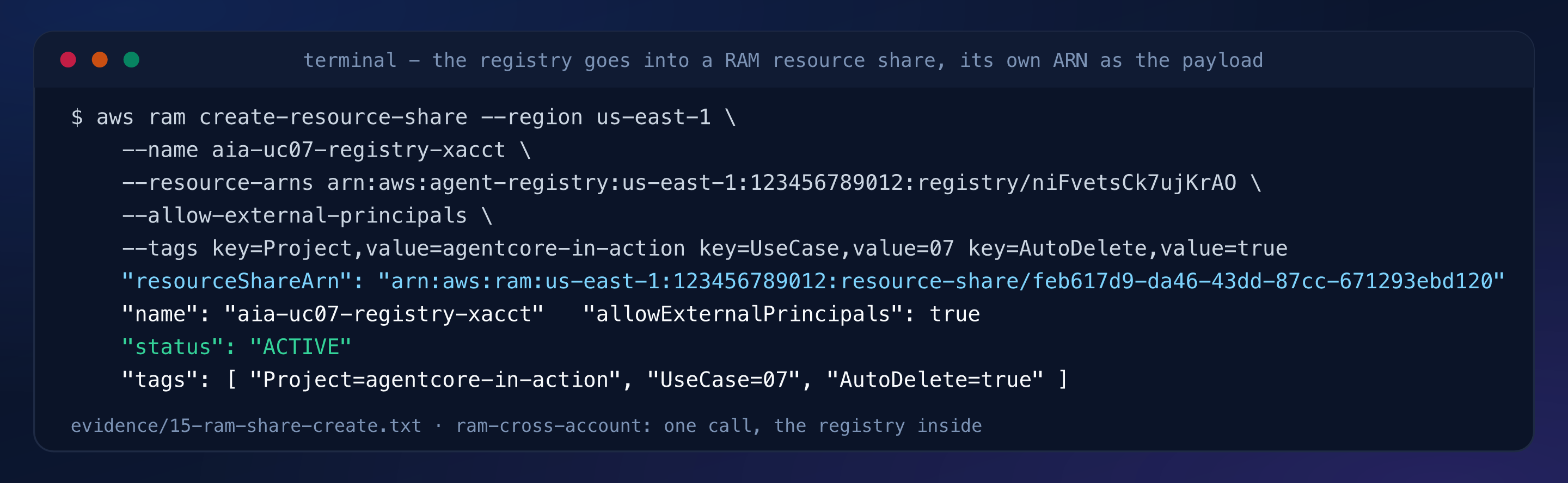
The catalog is one registry with two records. Note the namespace — it is
agent-registry, not bedrock-agentcore:
aws agent-registry-control list-registries --region us-east-1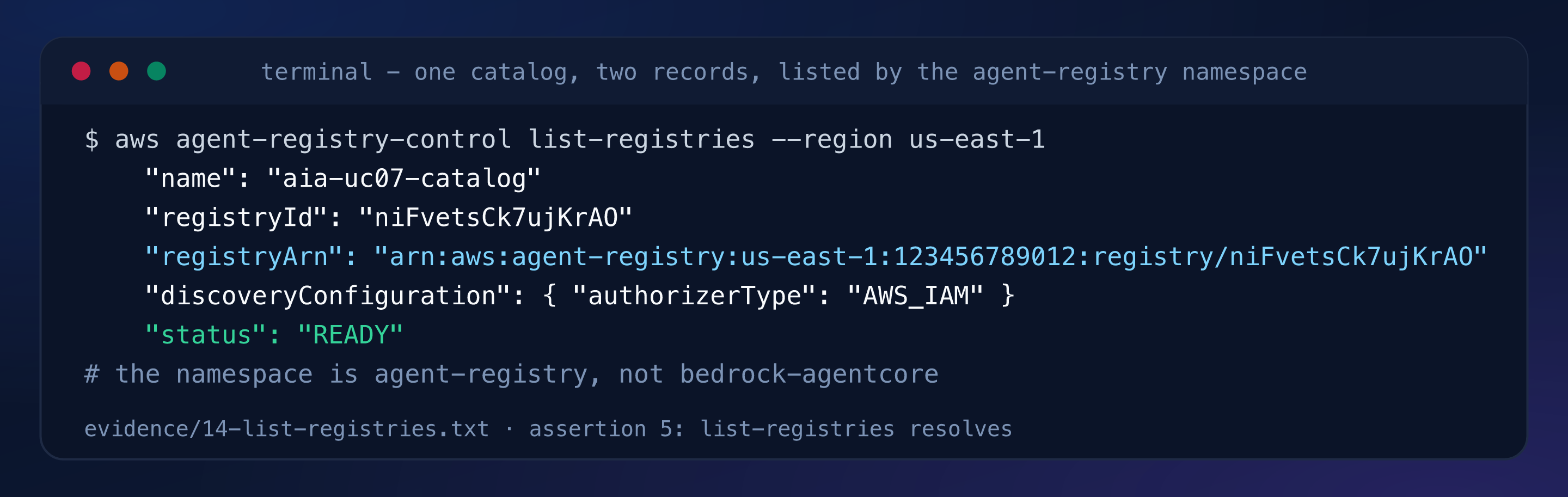
Search is the reason the catalog exists. The query never names the record:
aws agent-registry search-discoverable-registry-records --region us-east-1 \
  --registry-id niFvetsCk7ujKrAO --search-query "payment processing"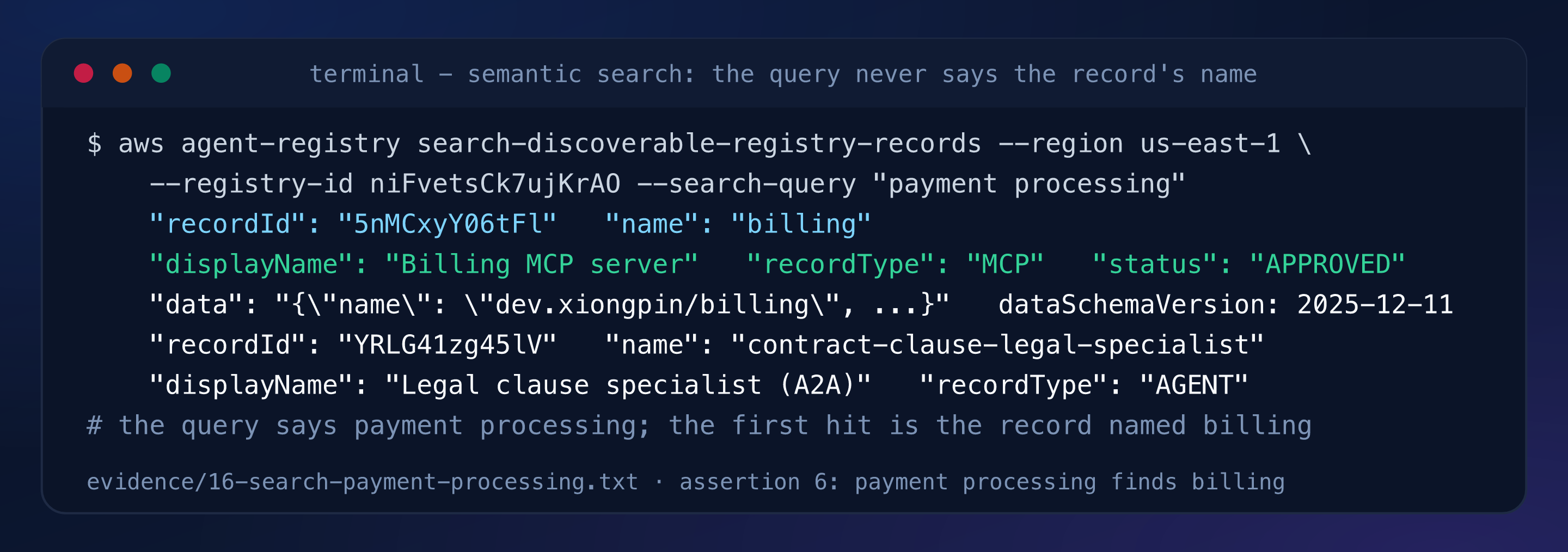
And the registry itself rides RAM, which is the whole story of ram-cross-account:
aws ram get-resource-shares --region us-east-1 \
  --resource-owner SELF --name aia-uc07-registry-xacct \
  --resource-share-status ACTIVE
aws ram list-resources --region us-east-1 \
  --resource-owner SELF \
  --resource-share-arn arn:aws:ram:us-east-1:123456789012:resource-share/feb617d9-da46-43dd-87cc-671293ebd120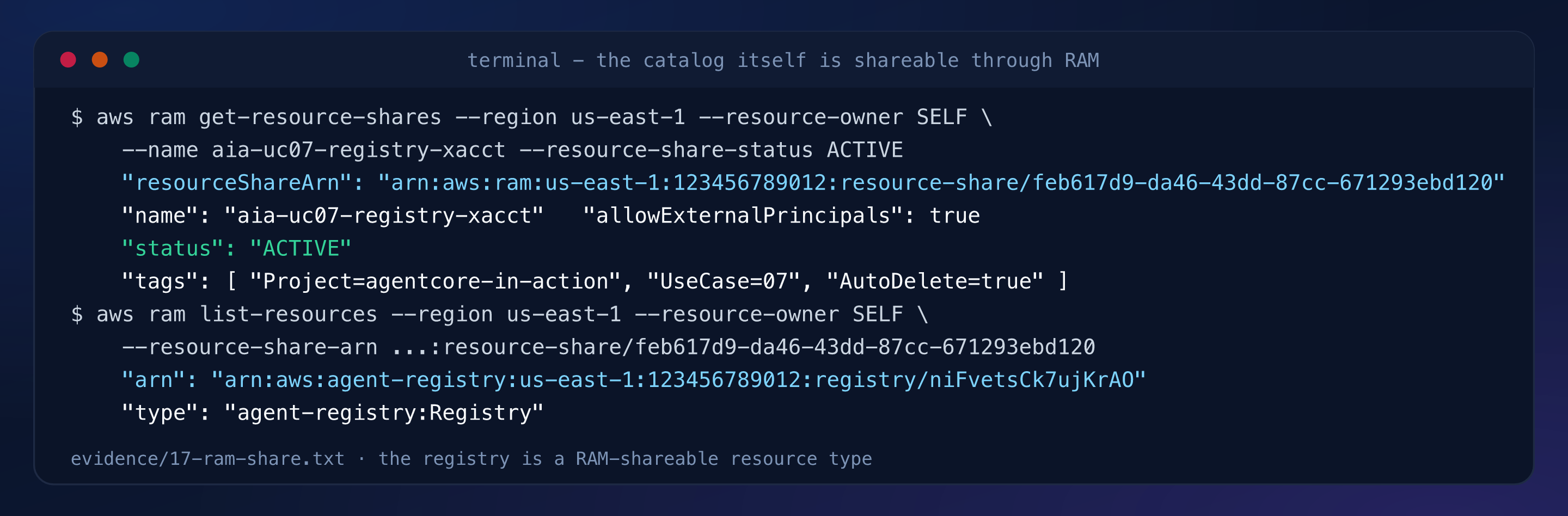
Observability needs no extra wiring: agentcore traces list finds the
invocations and traces get downloads one, span included:
agentcore traces list --runtime aia_uc07_orchestrator --limit 5
agentcore traces get 6ae68aae0be02f262af76e4121aa04e9 --runtime aia_uc07_orchestrator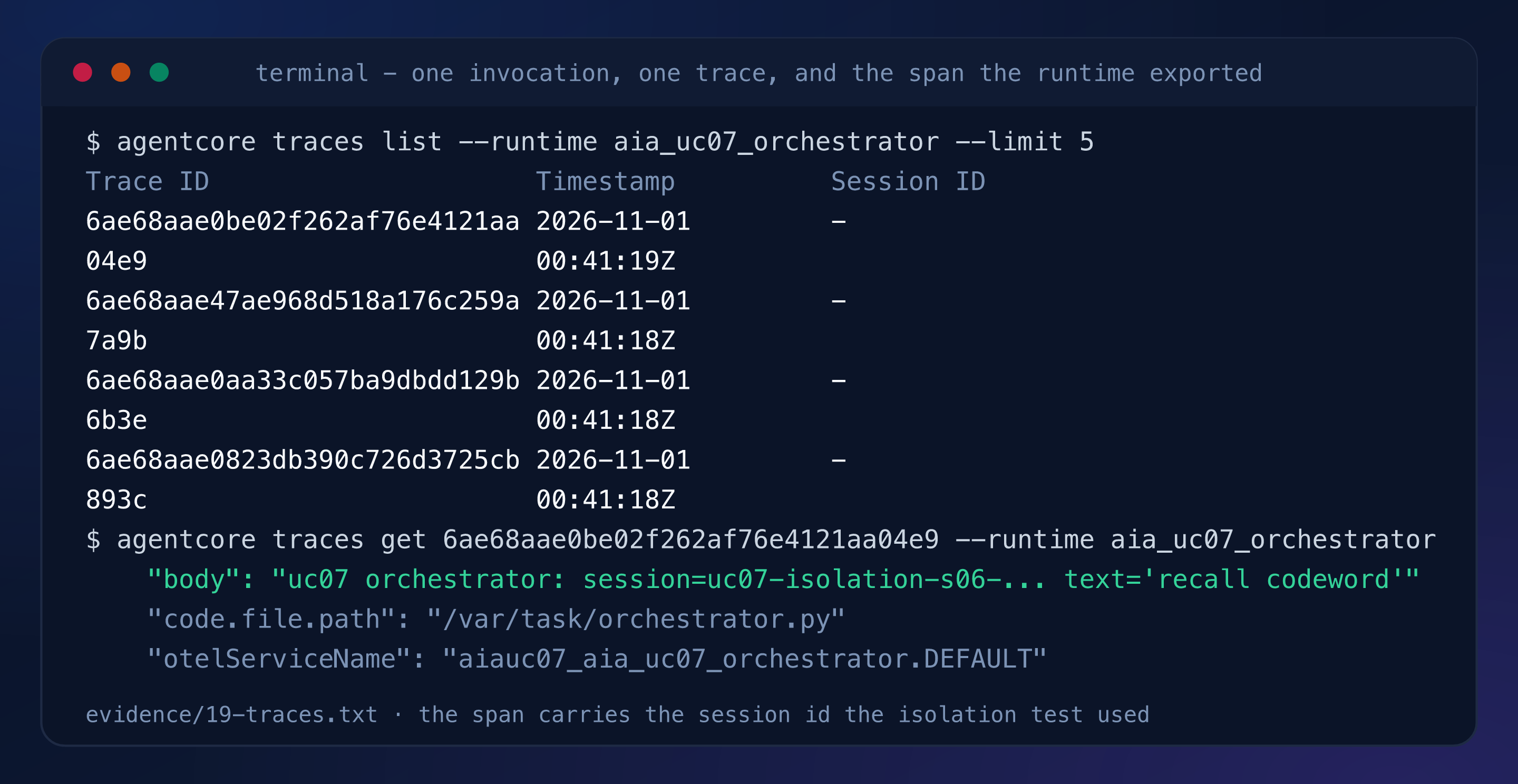
Teardown is two halves. remove all -y empties the contract, then the
deploy reconciles the stack down — and it also empties both
agentcore/agentcore.json and agentcore/aws-targets.json, which is why
the status prints an empty target:
agentcore remove all -y
agentcore deploy -y --target default
agentcore status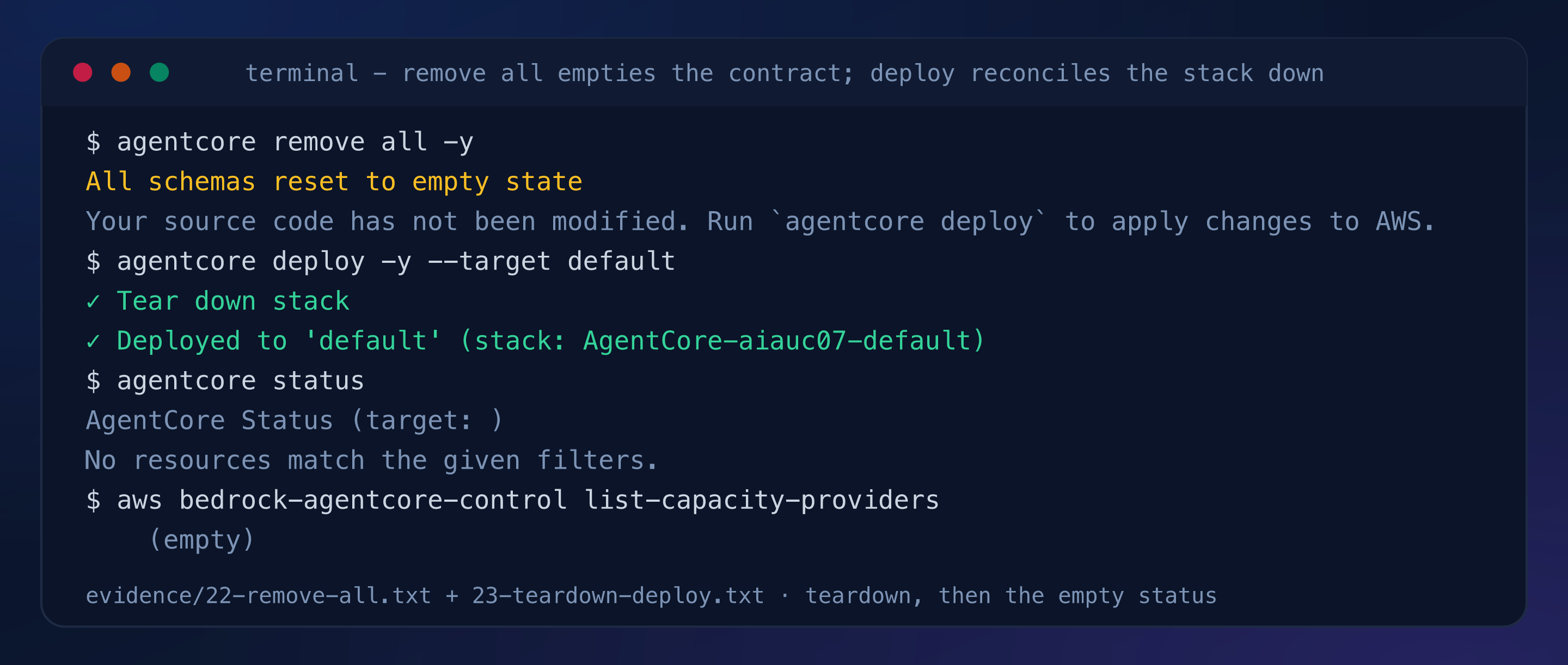
Restore both JSON files from git, deploy again, and the tag query confirms the account holds nothing but this use case’s resources. Three RAM-share records are ghosts of shares deleted earlier in the session, and the two aiauc05 records are orphaned tag records whose harness was deleted in another session — the tagging API returns 404 for the harnesses and 400 for the shares, because the resource behind each record is gone:
aws resourcegroupstaggingapi get-resources --region us-east-1 \
  --tag-filters Key=Project,Values=agentcore-in-action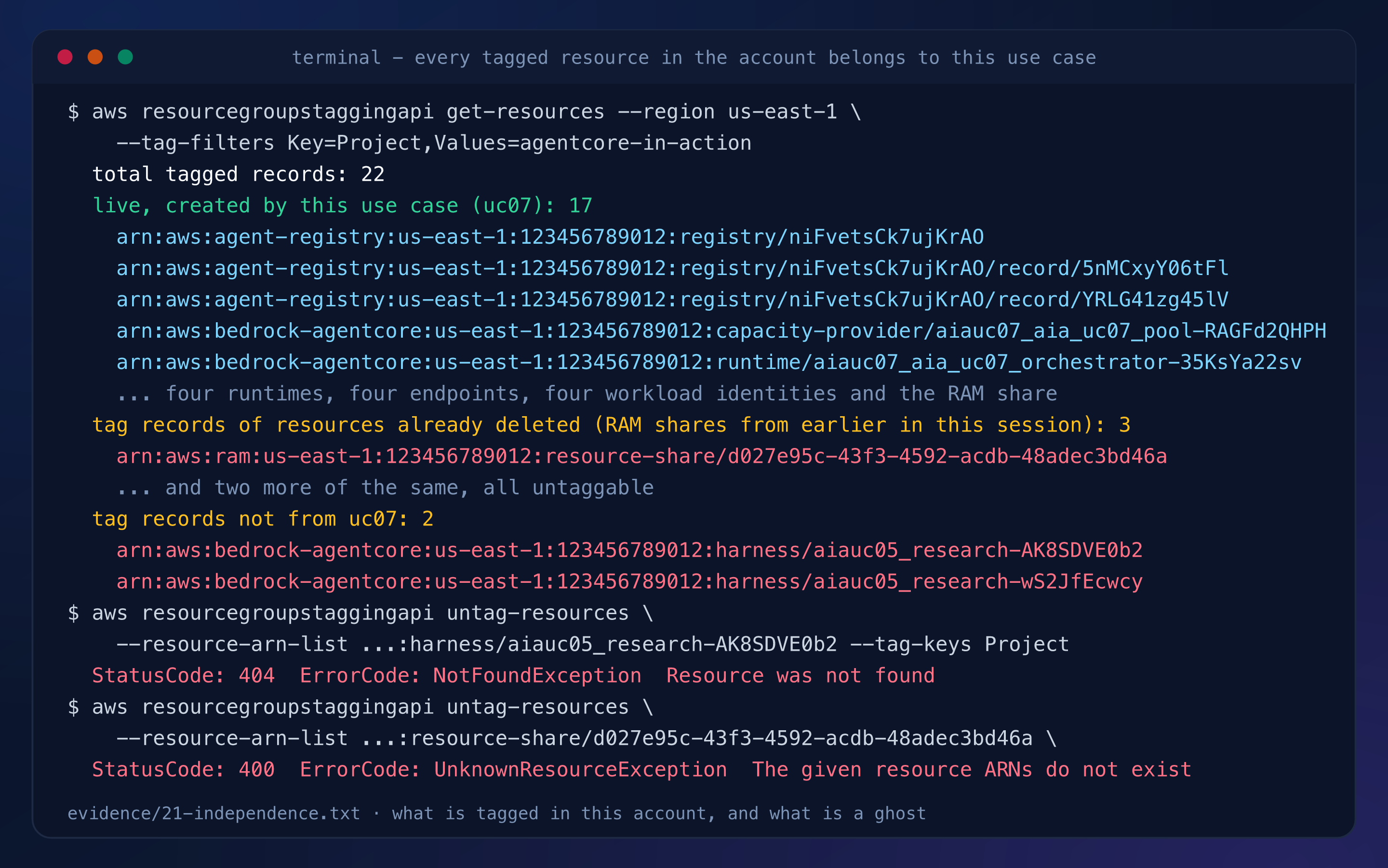
The tag list is also the inventory of what remove all never touches. The
registry and the RAM share are not in the CLI contract, so they are deleted
with the AWS CLI, share first, then the records, then the registry:
aws ram delete-resource-share --region us-east-1 \
  --resource-share-arn arn:aws:ram:us-east-1:123456789012:resource-share/feb617d9-da46-43dd-87cc-671293ebd120
aws agent-registry-control delete-registry-record --region us-east-1 \
  --registry-id niFvetsCk7ujKrAO --record-id 5nMCxyY06tFl
aws agent-registry-control delete-registry-record --region us-east-1 \
  --registry-id niFvetsCk7ujKrAO --record-id YRLG41zg45lV
aws agent-registry-control delete-registry --region us-east-1 \
  --registry-id niFvetsCk7ujKrAO
aws agent-registry-control list-registries --region us-east-1
aws ram get-resource-shares --region us-east-1 --resource-owner SELF \
  --name aia-uc07-registry-xacct --resource-share-status ACTIVE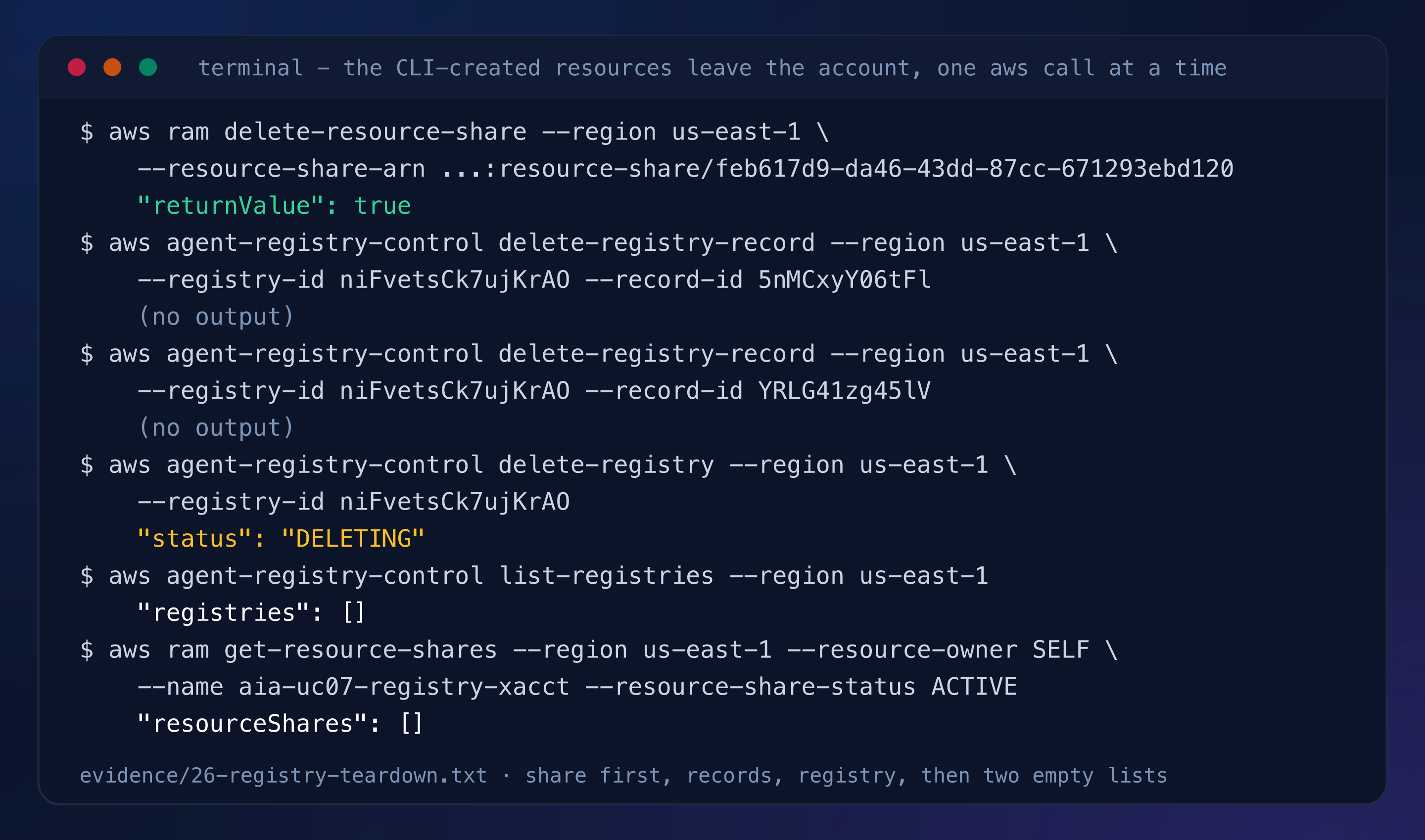
What survives is deliberate: the CDK bootstrap stack and its asset bucket
are account-level and reused across the whole series, and the runtime log
groups keep the traces above. Everything else from this use case is gone —
but only because those four deletions ran. Skip them, and the registry and
its share stay in the account, invisible to agentcore remove all, until
you delete them.
What it produced#
The review request produced two completed A2A tasks in one 95.0-second
invocation. The deep scan accepted at 0.0 seconds and completed at 115.0
seconds, while the same work asked for blocking died at 184.9 seconds of
client read timeout — the async pattern is not a nicety, it is the only way
past the ceiling. Barge-in canceled a working stream at 12.1 seconds. Ten
sessions recalled ten distinct codewords. The MCP server answered tools/call
in 72.5 seconds cold on its own m7g.large and c7g.large pool. The
registry listed on the first call, search resolved payment processing to
billing, the RAM share sat ACTIVE, and every invocation left a trace whose
span quotes the exact session id the isolation test used.
Troubleshooting#
ListAgentRuntimesreturns names with the project prefix:aiauc07_aia_uc07_legal, notaia_uc07_legal. Match by suffix, never by equality.GetAgentCardwraps the card in anagentCardkey; unwrap it before reading skills.- The control-plane IAM prefix is
bedrock-agentcore:, notbedrock-agentcore-control:. The wrong prefix fails silently through IAM propagation for minutes at a time. t3.mediumis rejected by CreateCapacityProvider in us-east-1, and the CodeZip artifact built on this Mac is Linux aarch64, so the pool must beLINUX_ARM64with Graviton types. Capacity providers are immutable after creation — change means delete and recreate, and you cannot attach one to an existing runtime.agentcore invokecannot parse an AG-UI SSE response; useaws bedrock-agentcore invoke-agent-runtime --accept text/event-stream.- The registry MCP descriptor validates hard against
2025-12-11: a tools block inadditionalDataand a description over about a hundred characters both fail. Ship the minimal name-description-version document. - RAM tags are
key=K,value=V, and a deleted resource can linger as a tag ghost that returns 404 on untag.
Takeaways#
- Protocols compose. The caller sees one AG-UI stream while the orchestrator runs A2A underneath, and none of the three protocols leaks into another.
- Non-blocking is a protocol feature, not a retry policy: accepted at 0.0 seconds, completed at 115.0 seconds, versus a dead client at 184.9 seconds of read timeout for the identical work.
- Barge-in is only real if the executor cooperates; the canceled state arriving on the very next stream event is the proof, not the cancel call.
- One microVM per session id is a load-bearing property — it is what makes a plain dict a correct session store, and it is exactly what the codeword loop exercises.
- Pin instance types when the workload has a compute shape, and pin them at creation: the capacity provider and its attachment are both immutable.
- A catalog earns its keep the day search matters more than naming: the record is called billing, the question says payment processing, and the semantic index is what connects them — across accounts, through RAM.